
Glowing interconnected network nodes with abstract tech icons on a sleek background, illustrating futuristic digital marketing and data flow.

Why MSP Marketing Isn’t Working in 2026 and What to Do About It

Here’s something that’ll make you scratch your head: MSP marketing 2026 is a paradox wrapped in a riddle. The demand for managed IT services has never been higher. Businesses are practically begging for cybersecurity help, cloud migrations, and 24/7 support. Yet somehow, most MSPs are watching their marketing budgets evaporate faster than free donuts at a tech conference.

The truth? Why MSP marketing isn’t working boils down to a fundamental disconnect. MSPs are still marketing like it’s 2019, while buyers have evolved into research obsessed, skeptical decision makers who can smell a generic sales pitch from three LinkedIn messages away. The MSP challenges in 2026 aren’t about lack of opportunity. They’re about marketing effectiveness getting kneecapped by outdated strategies, cookie cutter messaging, and a stubborn refusal to adapt to how people actually buy IT services now.

In this article, you’ll discover:

  • The specific reasons your current marketing approach is bleeding money
  • How buyer behavior has fundamentally changed (and why your competitors are just as confused)
  • Practical, no-nonsense strategies that actually generate qualified leads
  • Real tactics for standing out in a market where everyone claims to be “your trusted IT partner”

To address these issues, consider implementing some innovative strategies such as writing your own guarantee which can significantly enhance your appeal to potential clients.

Also, keep an eye on the latest trends in the industry by following reliable news sources and regularly checking the latest news related to MSP marketing.

Remember, if you’re finding that your clients are indecisive, it might be worth reflecting on whether you’re also exhibiting signs of indecision in your approach. As suggested in this insightful piece about client indecisiveness, understanding this could be key to turning your marketing strategy around.

Let’s dig into why your marketing isn’t working and fix it.

The Shift in MSP Marketing Strategies

The MSP market trends tell a fascinating story. Businesses are practically throwing money at managed service providers right now. AI projects, cybersecurity threats, and the never-ending parade of compliance requirements have created a perfect storm of demand. Every company from mom and pop shops to mid-sized manufacturers needs IT support, and they need it yesterday.

Here’s the kicker though: Managed Service Provider growth has exploded so dramatically that you’re now competing with dozens (sometimes hundreds) of other MSPs in your local market. The competitive MSP landscape looks nothing like it did even three years ago. Your neighbor’s nephew who “knows computers” has suddenly rebranded himself as a managed service provider, and established IT companies are pivoting to MSP models faster than you can say “monthly recurring revenue.”

This shift has fundamentally changed the game. Remember when you could build an entire MSP business on referrals and a solid handshake? Those days are deader than Windows XP. The referral-based growth model that worked beautifully in 2015 simply can’t keep pace with your revenue goals in 2026. You need active marketing strategies like Salesforce lead generation that put your name in front of prospects before they even know they need help.

The digital transformation isn’t just something you sell to clients anymore. It’s something you need to embrace in your own marketing. Buyers today are researching MSPs the same way they research everything else: online, obsessively, and often at 11 PM when they can’t sleep because their current IT situation is giving them heartburn.

Buyer education has become the currency of trust. Prospects don’t want to be sold to immediately. They want to understand their options, learn about best practices, and feel confident they’re making informed decisions. The MSPs winning in 2026 are the ones treating marketing as an educational journey rather than a sales pitch.

Common Pitfalls in MSP Marketing Efforts

The gap between marketing effort and actual results keeps widening for most MSPs, and it’s not because they’re lazy or uninformed. They’re making predictable mistakes that sabotage their growth before it even starts.

Lack of Differentiation: The Commodity Trap

Walk through any MSP website and you’ll see the same tired promises: “24/7 support,” “proactive monitoring,” “cybersecurity expertise.” When every competitor sounds identical, prospects default to the only differentiator they understand: price. This race to the bottom destroys profit margins and attracts the worst clients (the ones who’ll leave you for a $50 monthly discount).

MSP brand positioning isn’t about being different for the sake of being quirky. It’s about carving out a specific space in your market’s mind. Maybe you’re the healthcare IT specialists who actually understand HIPAA compliance beyond surface-level checkboxes. Maybe you’re the manufacturing MSP who prevents production downtime through predictive maintenance. Your unique value proposition should make prospects think “oh, they get my specific problems” rather than “sure, another IT company.”

The MSPs winning in 2026 have stopped trying to be everything to everyone. They’ve picked their lane, developed genuine MSP differentiation, and speak directly to the pain points that keep their ideal clients up at 3 AM.

Targeting the Wrong Prospects at the Wrong Time

Here’s where good intentions meet brutal reality. You spot a 200-employee company that clearly needs better IT support, so you pitch them a comprehensive $15,000/month managed services contract right out of the gate. They ghost you faster than a bad Tinder date.

Trust isn’t built through proposals. It’s built through proof.

Smart MSPs in 2026 lead with low-commitment offers: a cybersecurity audit, a network assessment, a one-time project that solves an immediate headache. These smaller engagements let prospects experience your expertise without betting their entire IT infrastructure on an unknown quantity. Once you’ve demonstrated competence and reliability, conversations about comprehensive agreements flow naturally.

The marketing misstep happens when campaigns target prospects at the wrong readiness stage. Someone just starting to research MSP services doesn’t need aggressive sales pitches. They need education, reassurance, and gentle guidance.

Overreliance on Referral-Based Growth

Referrals feel comfortable. They worked when you were a scrappy startup, so why mess with success? Because referral-dependent businesses are one bad quarter away from panic mode.

The transition from passive referrals to proactive outreach terrifies many MSP owners. They dump $10,000 into Google Ads without testing messaging, blow their budget in three weeks with zero results, then declare “marketing doesn’t work for us” while retreating to their referral comfort zone.

Successful marketing requires experimentation across multiple channels. Test LinkedIn outreach with 50 prospects before committing to 500. Run small content campaigns before hiring a full time writer. Strategic planning means accepting that some tactics will flop, and that’s valuable data rather than wasted money.

Long Sales Cycles Demand Patient Nurturing

Switching MSPs isn’t like buying a new coffee maker. It’s a relationship decision with massive operational implications. The average MSP sales cycle stretches 6-12 months, yet many marketing efforts expect instant conversions.

Lead nurturing isn’t optional anymore; it’s the entire game

Navigating a Crowded Digital Space with Multi-channel Strategies

The digital landscape for MSPs in 2026 resembles a packed highway during rush hour. Every competitor is fighting for the same attention, and why MSP marketing isn’t working often boils down to one critical mistake: putting all your eggs in one basket. You might have the world’s best LinkedIn strategy, but if your prospects are researching solutions on Google at 2 AM, you’re invisible.

Multi-channel marketing isn’t just a fancy buzzword. It’s your survival strategy in a marketplace where decision-makers bounce between platforms like caffeinated pinballs. Think about your own buying behavior. You probably Google a service, check their LinkedIn, read reviews, scroll through their social media, and then maybe fill out a contact form. Your prospects do the exact same thing.

Here’s what a robust multi-channel approach actually looks like:

  • SEO for MSPs forms your foundation, capturing prospects actively searching for solutions to their IT headaches
  • Content marketing establishes your expertise through blogs, guides, and resources that answer real questions
  • Paid advertising puts you in front of decision makers at critical moments when they’re ready to evaluate options
  • Social media engagement builds relationships and keeps your brand top of mind during those long buying cycles
  • Cold email campaigns reach prospects who haven’t found you yet but fit your ideal client profile perfectly

The magic happens when these channels work together. Someone sees your LinkedIn post, Googles your company, reads three blog posts, gets retargeted with an ad, and finally responds to your personalized cold email. That’s not seven different marketing failures. That’s one successful conversion that required seven touchpoints.

Single-channel dependency is like fishing with one line in an ocean full of fish. You might catch something, but you’re leaving serious money on the table. Spread your nets across multiple platforms, and you’ll stop wondering why your marketing isn’t working.

The Role of LinkedIn Leads in MSP Marketing

LinkedIn has great potential for generating leads for Managed Service Providers (MSPs), but many campaigns fail to deliver results. The platform allows you to directly connect with decision makers at companies who are currently discussing IT challenges, but LinkedIn lead generation challenges can affect even experienced marketers who use it as a platform for advertising rather than networking.

The main reason why LinkedIn leads may not be effective is because connections are viewed as one-time transactions. You may have come across these types of requests: someone sends you a connection request and immediately follows up with a lengthy sales pitch. Such LinkedIn outreach mistakes can damage trust before it is established. Prospects can sense desperation through their screens, and nothing conveys “I need your money” more than an unsolicited sales pitch in the first message.

Why Most LinkedIn Campaigns Fail

There are two common reasons why most LinkedIn campaigns fail:

  1. Poor targeting: Many marketers send connection requests to anyone with “CEO” in their title, regardless of the size or industry of the company, or their actual IT needs. This approach wastes both your time and theirs. For example, a manufacturing company with 500 employees has very different requirements than a law firm with 50 employees.
  2. Generic messaging: Marketers often use generic messages that could apply to any business in any industry. These messages get ignored because they lack specificity. Instead of saying “We help companies improve their IT infrastructure,” which is a common phrase used by many, you should provide specific details about how you have helped similar businesses in their industry.

Building Authentic LinkedIn Relationships

The MSPs who are successful on LinkedIn prioritize building relationships over making immediate sales. Here are some strategies they use:

  • They leave thoughtful comments on prospect posts to show genuine interest.
  • They share relevant industry insights without expecting anything in return.
  • They demonstrate expertise through creating their own content.

Start conversations by discussing specific pain points you have observed in their industry. Refer to recent news events that impact their sector. This shows that you have taken the time to research and understand their business before reaching out.

When it’s time to pitch your services, make sure to focus on solving their documented problems rather than emphasizing your own financial goals.

To overcome these challenges and fully utilize LinkedIn for lead generation, consider using a professional LinkedIn lead generation service. These services specialize in creating and implementing high converting LinkedIn and Email Lead Generation campaigns that target new business leads and appointments tailored specifically for you.

Implementing some essential tips for lead generation on LinkedIn can greatly increase your conversion rates and help grow your business. Remember that personalization at scale requires systems and templates that still feel human. Use automation only for follow-ups, not for initial contact. Your first outreach message should include specific references about their business, recent company news, or shared connections that establish genuine common ground.

Cold Email Campaigns: A Double Edged Sword for MSPs

Cold email campaigns sit in this weird spot where they can either be your best friend or your worst enemy. When done right, they open doors to conversations with decision makers who’d never find you otherwise. When done wrong? You’re just another spam message getting deleted faster than someone can say “unsubscribe.”

The biggest reason cold email not working for most MSPs comes down to one brutal truth: your emails sound like everyone else’s. “We provide comprehensive IT solutions” and “Let’s schedule a quick call” land with all the impact of a wet noodle. Prospects delete these messages before their coffee gets cold because they’ve seen the same pitch seventeen times this week.

Email deliverability issues compound the problem. You could craft the world’s most brilliant email, but if it lands in spam, it might as well not exist. Many MSPs blast out hundreds of emails without warming up their domains, using sketchy email lists, or triggering spam filters with pushy language. Your sender reputation tanks, and suddenly your legitimate outreach can’t reach anyone’s inbox.

Here’s where cold email strategies for MSPs need to get smarter:

  1. Segmentation saves everything. Stop sending the same message to a manufacturing plant manager and a law firm partner. They have completely different pain points, compliance requirements, and technology needs. Your email should prove you understand their specific world.
  2. Personalization goes beyond first names. Reference something real about their business. Mention a recent company announcement, a technology challenge specific to their industry, or a mutual connection. Show you did actual research instead of plugging their name into a template.
  3. Value before the ask. Lead with something useful like a relevant case study, industry benchmark data, or a specific observation about their current tech stack. Give them a reason to respond that isn’t just “because I want your business.”

The best cold email campaigns feel less like cold outreach and more like the start of an actual conversation between two professionals who might genuinely help each other.

What Successful MSP Marketing Looks Like in 2026

Building a Strong Brand Beyond Price and Speed

The race to the bottom stops here. When your marketing screams “we’re fast and cheap,” you’re basically begging prospects to shop around for someone faster and cheaper. The MSPs crushing it in 2026 have figured out something different: they’re building brands around specialized expertise that makes price comparisons irrelevant.

Think about it. Would you rather be known as “the MSP that responds quickly” or “the MSP that prevented three healthcare practices from catastrophic HIPAA violations last year”? One of those positions makes you a commodity. The other makes you indispensable.

Successful MSPs are crafting messaging that showcases their unique service models and deep industry knowledge. They’re telling stories about the specific problems they solve, not listing generic IT services that every competitor offers. This approach answers the critical question of why MSP marketing isn’t working for so many: they’re all saying the same boring stuff.

Leveraging Inbound Marketing Tactics Effectively

The best inbound marketing for MSPs in 2026 looks nothing like the keyword-stuffed blog posts from five years ago. Today’s winning strategy involves creating genuinely helpful SEO optimized content that meets prospects exactly where they are in their research journey.

Your potential clients are Googling questions at 11 PM when their server acts weird. They’re searching for compliance requirements. They’re trying to figure out if their current IT setup can handle their growth plans. Smart MSPs create content that answers these real questions with actual expertise, not sales pitches disguised as advice.

This content does double duty: it builds trust with prospects who aren’t ready to buy yet, and it signals to search engines that you actually know your stuff.

  • Educational blog posts that break down complex IT concepts for business owners
  • Comprehensive guides addressing industry specific technology challenges
  • Case studies showing measurable results (with real numbers, not vague promises)
  • Video content explaining common IT issues in plain English

Combining Outbound Efforts with Strategic Targeting

Here’s where things get spicy. The MSPs winning in 2026 aren’t choosing between inbound and outbound marketing. They’re running both simultaneously with laser focused targeting.

Pay per click advertising hits prospects at critical decision moments. Someone searching “emergency IT support for law firms in Chicago” right now? That’s not research mode. That’s buying mode. Strategic PPC campaigns capture these high intent prospects when they’re actually ready to make a decision.

The key is matching your outbound intensity to prospect readiness. Cold outreach works when you’re targeting companies showing clear signs they need your services (recent funding rounds, new office openings, compliance deadlines approaching). Random spray and pray campaigns? Still garbage in 2026.

However, it’s important to remember that cookie cutter marketing plans are why MSP marketing isn’t working for most companies. You can’t copy what worked for an MSP in Seattle and expect identical results in Atlanta. Different markets, different buyer behaviors, different competitive landscapes.

Successful MSPs start with brutally honest assessments:

  • What’s our realistic marketing budget (not what we wish we had)?
  • Who exactly are we trying to reach (not “small businesses” but specific profiles)?
  • What makes us genuinely different (not what we hope makes us different)?
  • How long can we sustain marketing efforts before seeing returns?

They’re building marketing plans around

Optimizing Your Website & Utilizing Automation Tools for Lead Nurturing & Follow Up

Your website often serves as the first real conversation you have with a potential client. Unfortunately, many MSP sites currently communicate in jargon that only other IT professionals understand. The real issue? Your prospects are not interested in your “enterprise grade infrastructure solutions” or “multi-layered security protocols.” They want peace of mind knowing their business won’t come to a standstill due to a ransomware attack.

Making Your Website Actually Work for You

Website design for MSPs should eliminate the technical jargon and focus on the actual problems you’re solving. Rather than listing every service acronym imaginable, your homepage should answer one straightforward question: “What’s in it for me?”

Your visitors need to see themselves in your messaging. A manufacturing company isn’t interested in your RMM tools; they want assurance that you can keep their production line running 24/7. A healthcare practice doesn’t care about your ticketing system; they need to know their patient data will remain secure.

Conversion optimization for IT services sites begins with honest calls to action that align with where prospects are in their journey:

  • Free Network Security Assessment is far more appealing than “Contact Us”
  • Download Our Ransomware Prevention Guide provides value before asking for commitment
  • Schedule a 15-Minute IT Health Check alleviates the fear of a high pressure sales pitch

Automation That Doesn’t Feel Like a Robot

The typical MSP deal takes 6-12 months to close. That’s a lengthy period to manually remember who downloaded what whitepaper three months ago. This is where automation tools come into play, handling the heavy lifting of maintaining top of mind awareness without becoming that annoying person who constantly calls.

Set up email sequences that deliver genuine value at each stage. For instance, someone who downloaded your cybersecurity guide could receive a follow up case study about a similar business you protected. Three weeks later, they could get an invite to a webinar on compliance requirements. The key is to space these touches out naturally while tracking engagement signals that indicate when someone is ready for an actual conversation.

To further streamline this process, consider leveraging outsourced lead generation services which can significantly enhance your lead nurturing process. Such services can provide highly qualified leads and sales opportunities specifically tailored for B2B technology companies like yours, making your website optimization efforts even more effective.

The Future is Now: Embracing AI in MSP Marketing Strategy

AI in marketing 2026 isn’t some far off concept anymore. It’s here, it’s working, and MSPs who aren’t using it are basically bringing a flip phone to a smartphone fight.

1. Predictive analytics that actually predict things

AI tools can now analyze thousands of data points from your CRM, website interactions, and engagement patterns to tell you which leads are actually ready to buy versus which ones are just tire kicking. No more wasting hours on discovery calls with prospects who aren’t ready to commit. The AI does the heavy lifting, scoring leads based on behavior patterns that humans would miss even after three cups of coffee.

2. Personalization at scale without losing your mind

You know those cold emails that sound like they were written by a robot? Well, now robots write emails that sound human. AI generated insights pull from prospect company data, recent news, tech stack information, and engagement history to craft messages that actually resonate. You’re not copy pasting the same template to 500 people anymore.

3. Learning from your wins and losses

Every response (or lack thereof) trains the system to get better at identifying your ideal prospects and crafting messages they’ll actually open. Your marketing gets smarter while you sleep.

4. Talking to the right people at the right time with the right message

MSPs using AI powered lead qualification are seeing 40-60% improvements in conversion rates simply because they’re talking to the right people at the right time with the right message. That’s not magic, that’s just smart use of technology you probably already recommend to your clients.

But remember, while AI is transforming MSP marketing strategies, enhancing your SEO strategy is equally important for achieving long term growth. In addition, understanding the B2B IT growth landscape can provide valuable insights into how to leverage these technologies effectively for maximum impact.

Case Studies & Success Stories Demonstrating Effective Modern MSP Marketing

Here are some real life examples of successful IT service marketing in 2026. These stories come from managed service providers (MSPs) who discovered why their competitors’ marketing strategies were ineffective and made changes accordingly.

1. The Chicago MSP That Ditched “We Do Everything”

A mid-sized IT provider in Chicago was struggling to stand out from the competition. They decided to focus on a specific niche and became experts in healthcare IT compliance. As a result, they revamped their entire marketing strategy to highlight their knowledge of HIPAA regulations. Within eight months:

  • LinkedIn content focused solely on healthcare compliance challenges generated 3x more qualified leads than their previous generic tech posts
  • Cold email campaigns targeting medical practices achieved 18% response rates (compared to their previous 2%)
  • Their website traffic from healthcare specific keywords jumped 240%

The surprising part? They actually turned away potential clients outside the healthcare industry, which may seem counterintuitive but created significant word-of-mouth buzz among their target market.

2. The Multi-Channel Dominator in Austin

An MSP based in Austin combined different marketing strategies to great effect. They optimized their educational content for search engines and also reached out to potential clients on LinkedIn while running retargeting ads. Here’s what they did:

  1. Published weekly guides on preventing IT disasters that ranked well for local searches
  2. Ran personalized LinkedIn campaigns targeting decision makers who visited their website
  3. Followed up with cold emails referencing specific blog posts prospects had read

As a result of these efforts, their sales pipeline grew by an impressive 156% year over year while the cost of acquiring new clients dropped by 40%. This case study demonstrates that integrated campaigns are more effective than relying on a single channel for marketing.

Book Your Free Marketing Audit with Jim Punzenberger

You’ve seen what works. You’ve learned why MSP marketing isn’t working for so many providers stuck in 2019 strategies. Now comes the honest question: where does your marketing actually stand?

Here’s the thing about running an MSP: you’re already juggling client emergencies, vendor relationships, and keeping your team running smoothly. The last thing you need is to waste another dollar on marketing tactics that sound good but deliver zilch.

Book a free audit with IT marketing expert Jim Punzenberger, creator of “The Managed Prospecting System” and widely accepted as the world’s leading expert on B2B Technology Marketing & Business Growth. This audit will provide a no nonsense assessment of what’s actually happening with your current efforts. This isn’t some generic checklist call. You’ll walk away with:

  • Specific gaps in your current marketing approach that are costing you qualified leads
  • Opportunities tailored to your local market and service offerings
  • A realistic roadmap that matches your budget and growth goals

The audit takes about 30 minutes. Zero pressure, zero fluff, just straight talk about what’s working and what needs to change.

Schedule your free audit here and let’s figure out how to get your marketing actually generating the leads you deserve. Because you didn’t build your MSP to compete on price alone.

FAQs (Frequently Asked Questions)

Why is MSP marketing not working effectively in 2026?

Many MSP marketing efforts are failing despite high market demand due to a lack of understanding of evolving buyer behaviors and increased competition. MSPs often struggle with differentiation, targeting the wrong prospects, overreliance on referrals, long sales cycles, and insufficient buyer education.

What are common pitfalls MSPs face in their marketing strategies?

Common pitfalls include lack of clear brand positioning and unique value propositions leading to price based competition, targeting prospects who aren’t ready for large contracts, depending too heavily on referral based growth without strategic outreach, underestimating long sales cycles requiring consistent lead nurturing, and neglecting the creation of high quality educational content to build trust.

How can MSPs navigate a crowded digital marketplace with multi-channel marketing?

MSPs should combine SEO, content marketing, paid advertising, social media engagement, and cold email campaigns to avoid dependency on a single channel. This multi-channel approach maximizes reach and impact by engaging potential clients across various platforms effectively.

What role does LinkedIn play in MSP lead generation and how can MSPs avoid common mistakes?

LinkedIn offers significant potential for MSP lead generation but success depends on proper targeting and authentic relationship building rather than overly salesy messaging. Avoiding generic outreach and focusing on personalized engagement helps overcome common pitfalls that hinder LinkedIn marketing effectiveness.

How can cold email campaigns be optimized for better results in MSP marketing?

Cold email campaigns can be effective if they avoid generic or irrelevant messaging that leads to low open and response rates. Successful campaigns rely on segmentation and tailored messaging that resonates with specific prospect needs, improving deliverability and engagement.

What does successful MSP marketing look like in 2026?

Successful MSP marketing in 2026 involves building a strong brand beyond price competition by emphasizing specialized expertise or innovative services. It includes leveraging inbound tactics like SEO optimized educational content, combining outbound efforts such as targeted pay per click ads, developing comprehensive marketing plans aligned with business goals, optimizing websites for clarity and conversion, utilizing automation tools for lead nurturing, and embracing AI technologies for personalized outreach.
IT business owner reviewing LinkedIn and email marketing strategy to grow MSP beyond referrals and break through one million in revenue

How to Grow Your IT Services Business Beyond Referrals with LinkedIn & Email

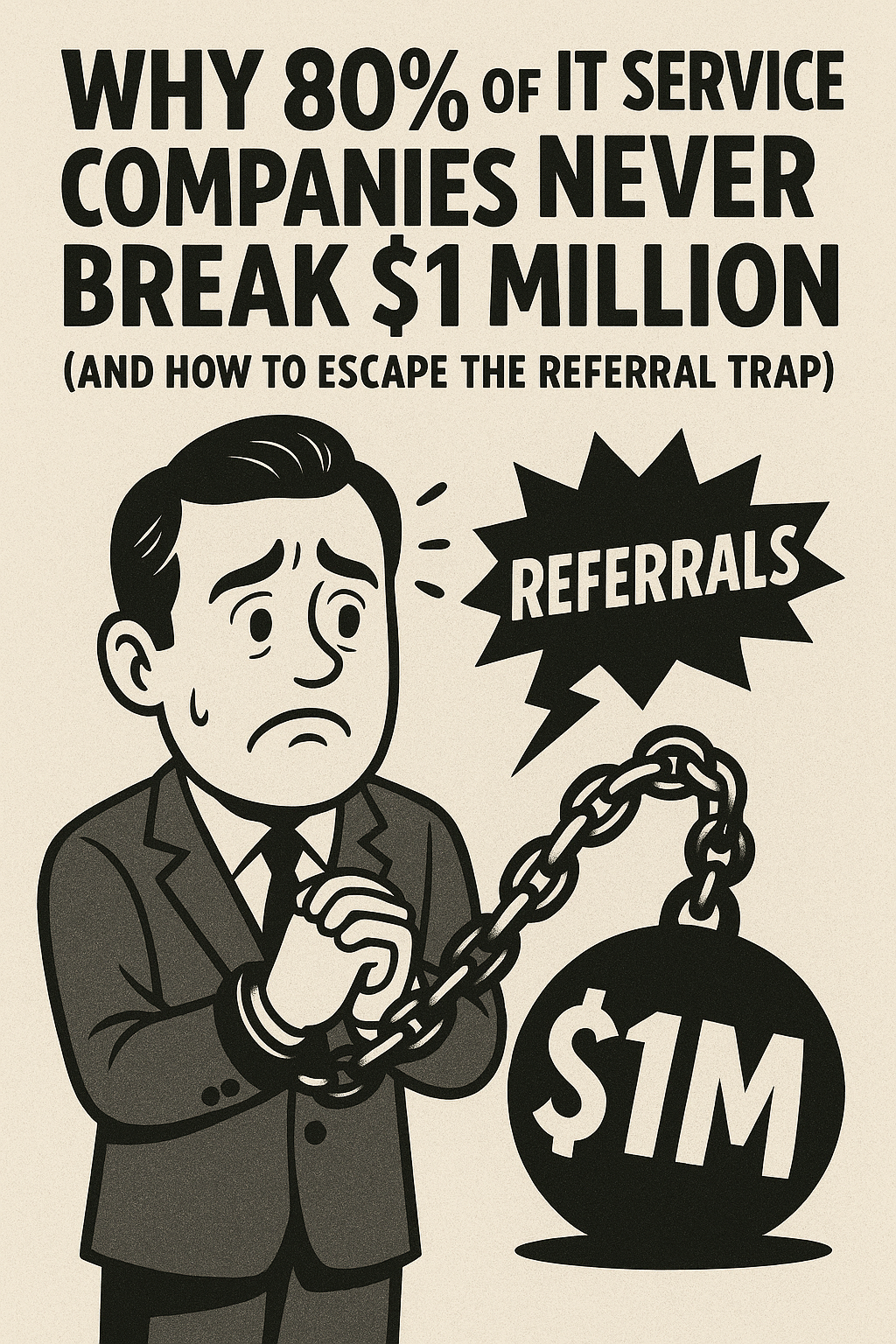
Why 80% of IT Service Companies Never Break $1 Million (And How to Escape the Referral Trap)

You’ve been running your IT services company for years. Maybe you’re an MSP, maybe you do break-fix work, perhaps you’re a VAR or manage SaaS implementations. You’ve got 5 to 20 employees, you do good work, and your clients love you.

But here’s the problem: you’re stuck.

You tried that expensive marketing program with the templated postcards. You bought the email blast system. You even hired that marketing person who promised the moon and delivered… well, nothing much. Now you’re back to waiting for referrals and hoping your phone rings.

Sound familiar?

If so, you’re not alone. According to comprehensive industry research from Service Leadership and Robin Robins’ Technology Marketing Toolkit, approximately 80% of IT service providers remain trapped under $1 million in annual revenue. The primary culprit? Lack of systematic marketing approaches that actually work for B2B IT services.

But here’s what the data doesn’t tell you: most IT business owners have tried marketing. They’ve spent money. They’ve followed the “proven systems.” They’ve sent the postcards and emails and newsletters.

So why didn’t it work?

The Brutal Truth About Referral-Only Growth

Let me share something that might hurt a bit: each of your clients has exactly 3 to 7 business contacts they feel comfortable referring to you. That’s it. Once those introductions are exhausted, that referral source essentially stops producing.

This comes from Managed Prospecting System’s analysis of thousands of IT service businesses over the past several years. Think about your own network. How many business owners do you know well enough to refer to a critical service provider? Probably not many.

COVID-19 made this worse by eliminating networking events where organic referrals happened. Now, economic uncertainty makes clients hesitant to make referrals because they fear responsibility if things go wrong. Nobody wants to be the person who recommended the IT company that had a security breach.

While referral-based leads are fantastic (they close at 50% rates versus 20% for marketing leads according to NinjaOne research), they simply cannot scale. You cannot build a million-dollar business on 3 to 7 introductions per client, especially when you’re only adding 5 to 12 new clients per year through referrals.

Why Copy-Paste Marketing Fails IT Service Businesses

Here’s where the IT services industry got it wrong.

For the past 20 years, the dominant marketing approach has been what I call “spray and pray” copy-paste marketing. You know the type: buy the templates, send the same postcards as every other MSP in your market, blast the same email newsletters with the same subject lines, hope something sticks.

The problem isn’t that these approaches never work. Some companies see results. The problem is they work for the first movers and then quickly become saturated.

When every MSP in your city is sending the same “Is Your Network Secure?” postcard and the same “5 Ways Hackers Attack Small Businesses” email, you’re not differentiated. You’re noise. You’re competing on price because you look identical to everyone else.

Robin Robins’ Technology Marketing Toolkit has documented impressive results, with clients achieving 40% revenue growth in the first year and some reaching 147% growth. But here’s what they don’t emphasize: those are the results from their top-performing clients who implemented everything perfectly, often invested $50,000+ in their programs, and got in early.

What about everyone else who bought the system?

According to ConnectWise’s MSP Marketing Report, 85% of IT service providers have one or zero dedicated marketing staff, 58% admit to little or no in-house marketing experience, and 42% spend under $10,000 annually on marketing. These companies bought the templates, sent a few campaigns half-heartedly, saw minimal results, and went back to waiting for referrals.

The copy-paste approach fundamentally misunderstands B2B IT marketing. Small business owners don’t want to buy from the company with the cleverest postcard. They want to buy from someone they know, like, and trust. Someone who understands their specific business challenges. Someone who feels like a real person, not a marketing machine.

The Real Cost of Not Having a System

Let’s talk numbers, because this is where it gets serious.

A typical $500,000 to $900,000 revenue IT services company (the range most businesses with 5 to 20 employees fall into) should be achieving $495,000 in owner compensation once they reach $4.5 million in revenue, according to Channel Futures MSP 501 2024 rankings data. That’s assuming healthy 11% EBITDA margins, which Service Leadership Index research shows is the industry average.

Compare that to CTO salaries ranging from $166,000 to $322,000 according to Glassdoor CTO salary data and ZipRecruiter CTO compensation reports. You went into business to make more than corporate salary, right?

But here’s the problem: without systematic marketing generating predictable pipeline, you’re stuck in the 80% who never break $1 million. Your owner compensation stays below corporate salaries. You’re working harder for less money than you’d make working for someone else.

The opportunity cost is staggering. According to Tortoise & Hare Software analysis, MSPs investing 7.5% of revenue in systematic marketing achieve 20% annual growth with 2:1 ROI within two years. A $750,000 revenue company investing $56,250 annually could reach $1.08 million in year two and $1.3 million in year three.

Without that system? You’re adding maybe $50,000 to $75,000 per year through referrals and client expansion. Over ten years, the wealth accumulation difference totals $2 million to $5 million according to the research synthesis.

That’s not a typo. By not implementing systematic marketing, you’re potentially leaving $2 million to $5 million on the table over the next decade.

What Actually Works: Personalized B2B Outreach

After working with thousands of IT service providers through Managed Prospecting System and hosting hundreds of episodes of the Prophets of IT Podcast, I’ve identified exactly what separates the companies breaking $1 million from those stuck below it.

It’s not templates. It’s not postcards. It’s not buying lists and blasting emails.

It’s personalized, systematic outreach using LinkedIn, email, and content that speaks directly to your ideal client’s specific business challenges.

Here’s what that looks like in practice:

LinkedIn Prospecting Done Right

LinkedIn is the most underutilized tool in IT services marketing. Not LinkedIn ads. Not automated connection request spam. Real, personalized outreach to decision makers at companies that fit your ideal client profile.

This means:

  • Identifying companies in your service area with 20 to 100 employees (or whatever your sweet spot is)
  • Finding the actual decision makers (not just connecting with everyone)
  • Sending personalized connection requests that reference something specific about their business
  • Following up with value-first messages that solve problems, not pitch services
  • Building real relationships over weeks and months, not days

The data shows LinkedIn outreach, when done properly, generates qualified conversations with IT buyers at a fraction of the cost of traditional marketing. You’re reaching people who already have IT pain points, already have budget authority, and are already in buying mode for companies like yours.

Email Sequences That Don’t Suck

Email marketing generates $36 to $42 per dollar spent according to Pronto Marketing’s 2024 MSP marketing analysis. That’s 3,600% to 4,200% ROI, higher than any other marketing channel.

But here’s the catch: it only works if you’re not sending the same templated garbage everyone else sends.

Effective email sequences for IT services:

  • Are triggered by specific behaviors or milestones (not just “it’s Tuesday”)
  • Reference the recipient’s industry, challenges, or recent news about their company
  • Provide genuine value in every email (insights, assessments, tools)
  • Come from a real person with a real signature and real contact info
  • Are part of a multi-touch campaign that includes LinkedIn and phone follow-up

When someone receives your email and thinks “wow, this person actually understands my business challenges,” you’ve created differentiation. When they receive the same cyber security checklist that 47 other MSPs sent this month, you’re just noise.

Content That Positions You as the Expert

Here’s where most IT companies get content marketing wrong: they write about what they want to talk about (their services, their technology, their certifications) instead of what their prospects care about (their problems, their risks, their opportunities).

Effective content for B2B IT marketing:

  • Addresses specific vertical industry challenges (manufacturing IT issues, healthcare compliance, professional services technology needs)
  • Provides actionable frameworks, not just generic advice
  • Demonstrates deep expertise without being salesy
  • Gets shared on LinkedIn where your prospects hang out
  • Supports your email and LinkedIn outreach by giving you something valuable to share

The companies breaking $1 million publish consistently, position themselves as advisors (not vendors), and use content to start conversations rather than close sales.

The Systematic Approach That Replaces Copy-Paste Marketing

Here’s what separates Managed Prospecting System from the copy-paste marketing programs that failed you:

We Don’t Do Templates

Every outreach message is personalized based on the prospect’s industry, company size, technology challenges, and recent business developments. Yes, this takes more work. Yes, it scales differently than blasting 10,000 identical emails. But it actually works because it creates real conversations with real decision makers.

We Focus on Relationships, Not Transactions

The copy-paste approach tries to generate immediate sales from cold prospects. Our approach builds relationships over 6 to 12 week cycles, nurturing prospects from cold to warm to ready-to-buy. This matches how B2B IT services are actually purchased (nobody hires an MSP from a postcard).

We Use the Channels Where IT Buyers Actually Are

LinkedIn is where business owners and IT decision makers spend time. Email is where they communicate about business problems. Content is what they consume when evaluating vendors. We focus on these channels because that’s where your prospects are, not because we have a product to sell you in those channels.

We Make It Systematic Without Making It Robotic

The goal isn’t to eliminate personalization. The goal is to systematize the process of finding prospects, researching them, reaching out personally, following up consistently, and moving them through a relationship-building journey. Think of it like a CRM workflow that prompts human action, not a marketing automation system that removes humans from the process.

According to Kaseya’s 2024 MSP Benchmark Survey of 984 respondents, customer acquisition emerged as the number one challenge for 36% of IT service providers, up dramatically from 24% in 2023. That’s a 50% increase in just one year. The problem is getting worse, not better.

Why? Because the old approaches are saturated. Every IT company is doing the same thing. The companies winning are the ones doing something different.

What It Takes to Break Through $1 Million

According to Service Leadership Index data, average MSP adjusted EBITDA stands at 11.1% worldwide, but the top 10% achieve 25% to 35% net profit margins. That’s the difference between a $1 million revenue company generating $111,000 in owner compensation versus $250,000 to $350,000.

The gap isn’t technology. It’s not talent. It’s not pricing.

It’s systematic customer acquisition that generates predictable pipeline at reasonable cost.

Industry best practices establish that IT service providers should invest approximately 3 months’ worth of Monthly Recurring Revenue to acquire a new client. For a client paying $5,000 monthly, that’s $15,000 to $20,000 customer acquisition cost. At these levels, the economics work favorably: a client paying $5,000 monthly over 14 years generates $840,000 in lifetime revenue.

But MSPs without systematic marketing face substantially higher effective acquisition costs. When your sales rep spends 3 months chasing a prospect who ghosts you, that’s $25,000 in fully loaded sales cost with zero return. When you spend $5,000 on a marketing campaign that generates one lukewarm lead, your cost per acquisition is through the roof.

The Managed Prospecting System approach generates qualified conversations at predictable cost, with clear ROI tracking, and systematic follow-up that doesn’t depend on your sales rep remembering to call people back.

The Real Question: How Long Are You Willing to Stay Stuck?

Here’s what I know after working with hundreds of IT service companies:

The ones who break through $1 million (and then $2 million, $3 million, and beyond) all make one critical decision: they stop waiting for referrals and implement systematic outreach.

They don’t wait for the perfect time. They don’t wait until they have more resources. They don’t wait until marketing gets “easier” or “less expensive.”

They recognize that every month they wait is a month of lost opportunity. According to the research, a $750,000 revenue IT services company without systematic marketing foregoes approximately $750,000 in cumulative opportunity cost over just two years by continuing with referral-only growth.

Think about that. Two years from now, you could have an additional $750,000 in cumulative revenue and profit. Or you could be exactly where you are now, just two years older and two years more frustrated.

The U.S. Bureau of Labor Statistics 2024 business survival data shows a 26.4% first-year failure rate for information technology services companies, the highest of all sectors. Over 10 years, 60.4% of service-based businesses fail. The ones that survive and thrive? They’re the ones who solve customer acquisition before they run out of runway.

Your Next Step

If you’re ready to stop waiting for referrals, stop throwing money at copy-paste marketing programs that don’t work, and start implementing systematic B2B outreach that actually generates pipeline, here’s what I recommend:

Visit managedprospectingsystem.com/how-mps-works to see exactly how we help IT service companies implement personalized LinkedIn and email outreach that builds real relationships with qualified prospects.

You’ll see:

  • How we identify and research your ideal prospects
  • How we craft personalized outreach that starts conversations
  • How we systematically follow up without being pushy
  • How we track ROI so you know exactly what’s working
  • How we help you break through $1 million (and beyond)

The copy-paste era is over. The companies winning in 2025 and beyond are the ones building real relationships with decision makers through personalized, systematic outreach.

The only question is whether you’ll be one of them.


Frequently Asked Questions

How is Managed Prospecting System different from other MSP marketing programs?

Most MSP marketing programs sell you templates, campaigns, and content that every other MSP is using. We build personalized outreach specific to your ideal prospects, using LinkedIn, email, and content that actually speaks to their business challenges. No two clients send the same messages because no two clients target the exact same prospects in the same way.

How long does it take to see results?

Most IT service companies start seeing qualified conversations within 30 to 45 days and first closed deals within 90 to 120 days. Unlike copy-paste marketing that promises instant results (and rarely delivers), we build relationships over 6 to 12 week cycles that match how B2B IT services are actually purchased.

What if I’ve tried LinkedIn outreach before and it didn’t work?

Most failed LinkedIn outreach attempts use automated tools that spam connection requests and pitch immediately. Our approach builds genuine relationships through personalized research, value-first messaging, and systematic follow-up that doesn’t feel salesy. If you’ve been doing automated spam, you haven’t actually tried LinkedIn prospecting.

How much does systematic marketing cost compared to referrals?

Industry research shows IT service providers should invest 7% to 10% of revenue in marketing. For a $750,000 revenue company, that’s $52,500 to $75,000 annually. This generates 20% growth with 2:1 to 5:1 ROI within two years according to Tortoise & Hare Software analysis. Referrals feel free but they limit you to 5 to 12 new clients per year maximum. Marketing costs money upfront but scales infinitely.

Do you only work with MSPs or all IT service businesses?

We work with MSPs, break-fix companies, VARs, SaaS implementation firms, and any B2B IT service provider with 5 to 20 employees looking to grow beyond referrals. The approach works regardless of your specific IT service model because it’s based on building relationships with decision makers, not selling a particular product.

What size company do I need to be to make this work?

Our sweet spot is IT service companies doing $500,000 to $2 million in revenue who are stuck and ready to implement systematic outreach. Below $500,000, you might not have the resources to fully execute. Above $2 million, you probably need a full marketing team in addition to systematic outreach. But we’ve worked with companies outside this range successfully.

How hands-on is this? Do you do it for me or teach me?

We do the heavy lifting (prospect research, message personalization, campaign management, follow-up tracking) while you focus on having conversations with qualified prospects. Think of us as your outsourced business development team that feeds qualified opportunities to your sales process. You’re not learning a system to implement yourself; you’re getting systematic outreach implemented for you.

What if I’m in a competitive market where lots of IT companies already serve my area?

Personalization is your competitive advantage. When every other IT company is sending the same templated messages, your personalized outreach that references the prospect’s specific business stands out dramatically. We’ve seen this work in highly saturated markets like New York, Los Angeles, Chicago, and other major metros where competition is intense.

Can I really get to $1 million revenue without spending $50,000 on marketing programs?

According to research from Tortoise & Hare Software and industry benchmarks, IT service providers investing 7.5% of revenue in systematic marketing achieve 20% annual growth. For a $750,000 revenue company, that’s $56,250 annual investment reaching $1.08 million in year two. You don’t need to spend $50,000 upfront; you scale investment as you grow. The key is systematic implementation, not massive budget.

What happens if I wait another year to implement systematic marketing?

Every month you wait is a month of lost opportunity. A $750,000 revenue company continuing referral-only growth adds maybe $50,000 to $75,000 per year. With systematic marketing generating 20% growth, you’d add $150,000 in year one. Over two years, the cumulative opportunity cost of waiting reaches approximately $750,000 according to industry analysis. The question isn’t whether to implement systematic marketing; it’s how much you’re willing to lose by delaying.

About the Author:

Jim Punzenberger is the creator of Managed Prospecting System, host of the Prophets of IT Podcast, and author of Zero Dollar Advertising Strategies. He has helped hundreds of IT service companies break through the $1 million revenue barrier through systematic LinkedIn and email prospecting that builds real relationships with qualified B2B prospects.

Sources and Citations:

This article synthesizes data from Service Leadership’s benchmarking platform, Datto’s 2025 State of the MSP Industry report (PDF available at https://www.datto.com/wp-content/uploads/dlm_uploads/DAT-2024-State-of-the-MSP-Report-1.pdf), Kaseya’s 2024 MSP Benchmark Survey (PDF available at https://www.kaseya.com/wp-content/uploads/dlm_uploads/2024/03/Whitepaper-2024-MSP-Benchmark-Survey_Kaseya.pdf), CompTIA IT Industry Outlook 2024 and State of the Channel 2024, ConnectWise MSP Marketing Report, Robin Robins’ Technology Marketing Toolkit, Channel Futures MSP 501 rankings, Pronto Marketing analysis, Tortoise & Hare Software research, and U.S. Bureau of Labor Statistics covering 2022-2025 performance data for North American IT service providers.

Start/Stop is killing your IT marketing

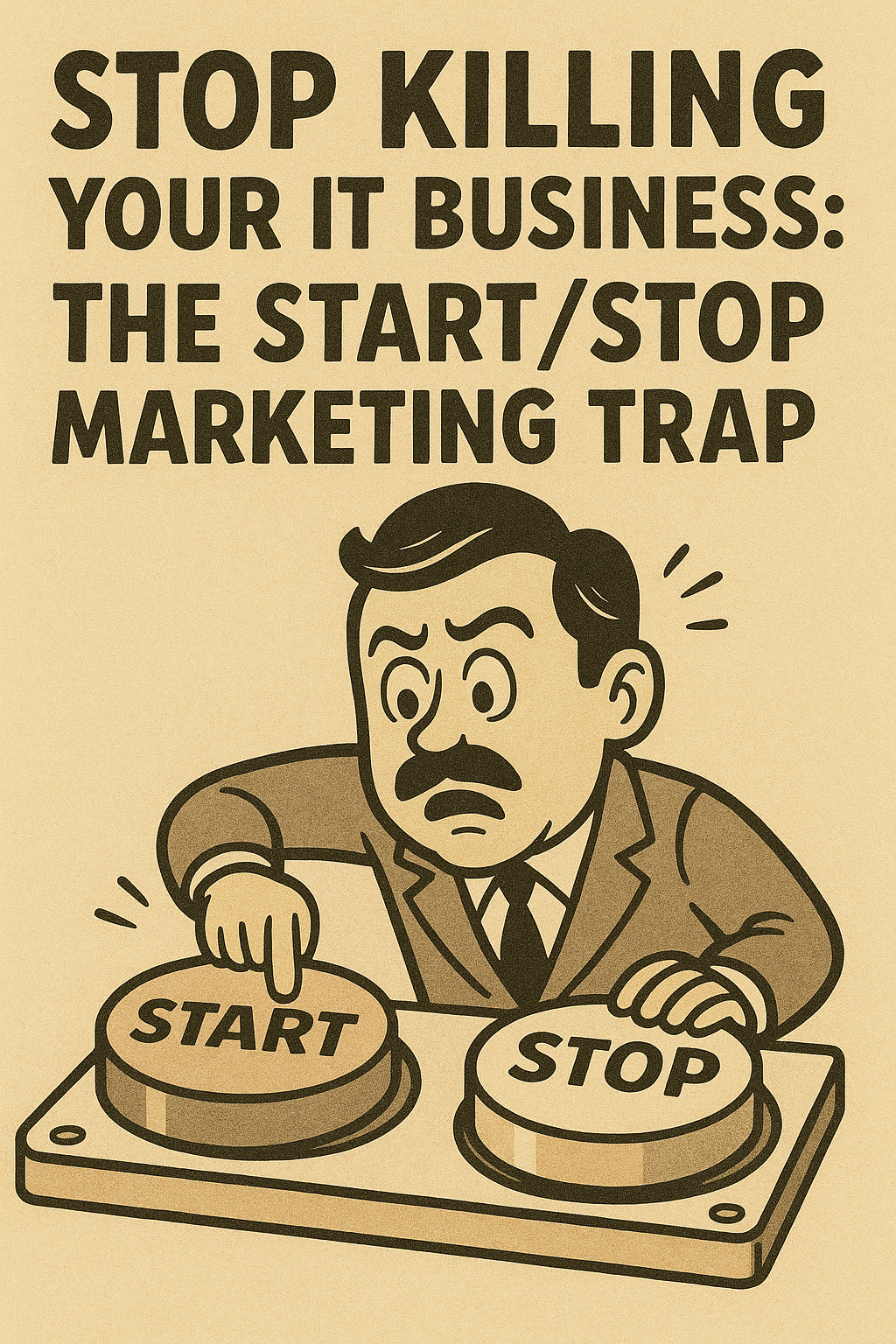
Stop Killing Your IT Business: The Start/Stop Marketing Trap

Introduction

Start/stop marketing is slowly killing your IT business. You know the pattern: launch a marketing campaign with enthusiasm, run it for 3-5 weeks, see minimal results, then abandon it completely. Sound familiar?

Here’s the brutal truth most IT service providers refuse to accept: marketing takes 4-6 months to start working. Yet most IT owners quit after just a few weeks, expecting instant results in a world that doesn’t work that way.

This destructive cycle is what I call the “start/stop marketing trap” the #1 killer of IT service providers. Every time you stop and restart, you’re not just wasting money. You’re destroying momentum, confusing prospects, and guaranteeing inconsistent lead flow.

Marketing isn’t an event. It’s infrastructure.

Just like you wouldn’t turn off your backup systems or network monitoring tools, you can’t treat marketing like an emergency response that only kicks in when revenue drops. Successful IT providers understand this fundamental truth: marketing requires sustained effort measured in months, not weeks.

The solution? A 90-day consistent marketing plan that builds momentum systematically. Execute the plan. Measure results. Turn those 90 days into forever.

Where do you start? LinkedIn. It’s the second place your prospects look after Google, and it’s the quickest win that creates immediate momentum for everything that follows.

However, be cautious of potential MSP marketing failures during this process, such as misusing platforms like BNI or Google Ads without a clear strategy.

To ensure success in your marketing efforts, consider implementing a write-your-own-guarantee strategy that can help build trust with your clients and prospects alike.

For more insights on navigating the complexities of B2B IT growth and overcoming common challenges faced by service providers, check out our latest news section where we regularly publish articles related to B2B IT growth and other relevant topics.

The Start/Stop Marketing Trap: Why It Kills IT Service Providers

The Cycle of Inconsistent Marketing

Picture this scenario: An IT service provider launches a LinkedIn campaign with enthusiasm, posts daily for three weeks, sends connection requests, and creates content. Week four arrives with no immediate results. Frustration sets in. By week five, the campaign dies a quiet death, abandoned like yesterday’s mechanical hard drives.

This pattern of inconsistent marketing destroys more IT businesses than any competitor ever could. The harsh reality? Marketing operates on a 4-6 month timeline before meaningful results emerge. Your prospects need multiple touchpoints across several months to move from awareness to trust to purchase decisions.

The Cost of Stopping

When you quit after 3-5 weeks, you’re stopping precisely when the foundation starts forming. Each restart means rebuilding from zero, burning cash and time while competitors who maintain consistency capture the leads you could have secured.

Marketing momentum works like compound interest, early efforts seem insignificant, but sustained activity creates exponential returns. Stop/start cycles break this momentum, forcing you back to square one repeatedly.

The Hidden Costs

The cost extends beyond wasted resources:

  • Prospects forget you exist during inactive periods
  • Search algorithms penalize inconsistent content creators
  • Referral partners lose confidence in unreliable marketing presence
  • Lead generation failure becomes a self-fulfilling prophecy

The Importance of Consistency

Your IT infrastructure runs 24/7 because downtime kills productivity. Your marketing deserves the same reliability commitment.

In these challenging times, it’s crucial for IT service providers to diversify their lead sources and avoid the referral crisis. Leveraging a Managed Prospecting System, can provide highly qualified lead generation and sales opportunities tailored for B2B technology companies. This system not only helps in maintaining consistent marketing efforts but also ensures that your business remains visible and relevant in the competitive landscape.

Marketing as Infrastructure: Changing Your Mindset

Your data backup runs every night without fail. Your network monitoring alerts you the moment something goes wrong. Your security patches deploy on schedule. These systems operate continuously because you understand the catastrophic cost of failure.

Marketing infrastructure deserves the same treatment.

Most IT service providers treat marketing like a fire drill, scrambling for clients only when revenue drops. This reactive approach creates the feast or famine cycle that keeps you perpetually stressed about your pipeline.

Successful IT providers think differently. They recognize that IT lead generation isn’t an emergency response, it’s a staple of your business. Just like you have systems for backing up data and monitoring networks, you need systems for generating leads and nurturing prospects.

Consider the parallels:

  • Backup systems run continuously to prevent data loss
  • Network monitoring operates 24/7 to catch issues before they become disasters
  • Security protocols maintain constant vigilance against threats
  • Marketing infrastructure should operate consistently, not sporadically

When you shift from treating marketing as an emergency fix to viewing it as essential infrastructure, something powerful happens. Your lead flow becomes predictable. Your sales conversations increase in quality because prospects encounter your expertise repeatedly. Your business develops the kind of sustainable growth that doesn’t depend on panic driven campaigns.

The consistent execution of marketing activities builds compound momentum that emergency efforts simply cannot match.

For instance, implementing a managed prospecting system can create and implement high converting LinkedIn and Email Lead Generation campaigns targeting new business leads and appointments ideal for you. It’s also crucial to understand that cold prospecting may not be yielding the desired results, but this can be fixed by adding warmth to your approach, as suggested in this guide.

Furthermore, leveraging effective Salesforce lead generation strategies can significantly enhance your business growth. And if you’re looking for specific advice on generating leads on LinkedIn, these 10 essential tips could prove invaluable. Lastly, understanding your ideal client avatar can greatly improve your lead generation efforts.

The 90-Day Marketing Plan: Your Roadmap to Consistency

Start/stop marketing is slowly killing your IT business. Most IT owners quit marketing after 3-5 weeks when it takes 4-6 months for marketing to mature. The solution? A structured 90-day plan that transforms sporadic efforts into a reliable lead generation system.

This isn’t about perfection. It’s about building the habit of consistent marketing execution. You optimize LinkedIn this week, leveraging a LinkedIn B2B lead generation service next week to create a content calendar, then start outreach in week three, measure and adjust in week four, and by day 90, you have a system that works.

Week 1: LinkedIn Optimization The Quick Win

LinkedIn deserves your immediate attention because it’s the second place prospects look after Google when researching IT providers. While your competitors fumble with generic profiles, you’ll create a magnet for ideal clients.

Your LinkedIn Profile Transformation Checklist:

1. Banner Optimization: Ditch the generic tech background with servers and cables. Create banner text with a clear value proposition for your ideal client. Instead of “IT Solutions,” try “We eliminate IT headaches for growing law firms.”

2. Outcome Focused Headline: Stop saying “IT Support” or worse “Managed Services.” Say what outcome you deliver: “I help law firms eliminate IT downtime and data breaches” or “I secure medical practices against cyber threats while ensuring HIPAA compliance.”

3. Conversational About Section: This isn’t your resume. Write it like you’re talking to a stressed business owner at 2 AM when their server crashed. Address their pain points directly: “Your IT shouldn’t keep you awake at night worrying about data breaches or system failures.”

4. Keyword Aligned Job Position: Make your current position match your headline and include keywords your prospects actually search for. “Chief Technology Officer” means nothing to a panicked business owner. “IT Security Specialist for Healthcare Practices” speaks their language.

5. Client Focused Skills Section: Remove “Microsoft Office,” “Leadership,” or “Team Building.” Add specific solutions your ideal clients desperately need:

  • AI Implementation
  • HIPAA Compliance
  • Ransomware Protection
  • Cloud Migration
  • Disaster Recovery Planning

Professional Profile Picture: If your profile picture is from your cousin’s wedding in 2019, fix that first. Prospects want to see a professional, not a wedding guest. Take a quality headshot that conveys competence and approachability, your smart phone camera with a solid background and good lighting will work.

This LinkedIn optimization creates immediate momentum. Prospects researching IT providers will find a professional who understands their specific challenges, not another generic “computer guy.” With the right strategies in place, such as utilizing a Managed Prospecting System for effective lead generation through platforms like LinkedIn and email, you can significantly improve your chances of success in this competitive industry.

Week 2: Creating a Content Calendar to Build Momentum

Your optimized LinkedIn profile sits there like a beautiful storefront with no customers walking by. Start Stop Marketing Is slowly killing your IT Business because most IT owners create content sporadically, posting when they remember or when panic sets in about lead flow.

A content calendar transforms random posting into a structured marketing machine that feeds your lead generation system consistently. Planning content prevents the feast or famine cycle that destroys momentum in your 90-day plan.

Essential Content Types for IT Service Providers:

  • Case Studies – “How we saved XYZ Law Firm $50,000 after their ransomware attack”
  • Cybersecurity Tips – Weekly security alerts and prevention strategies
  • Client Success Stories – Before/after scenarios showing tangible business outcomes
  • Industry Insights – Commentary on new threats, compliance changes, or technology trends
  • Problem/Solution Posts – Address common pain points your prospects face daily

Schedule posts for maximum visibility during business hours when decision makers scroll LinkedIn. Tuesday through Thursday, 8 AM to 11 AM typically generates highest engagement for B2B content.

Your content calendar becomes the backbone of consistent audience engagement. Each post not only builds authority and demonstrates expertise but also keeps your name visible to prospects researching IT solutions.

Content consistency separates thriving IT businesses from those trapped in the start stop cycle. Your prospects need to see you as the reliable expert who shows up consistently, not the vendor who disappears for months between desperate sales pushes. By leveraging a well structured content calendar, you can build market authority that sets you apart from competitors and attracts more leads.

Week 3: Starting Outreach Connecting With Prospects

Your optimized LinkedIn profile and content calendar have built the foundation. Week three transforms that foundation into active lead generation through strategic outreach. This is where your 90-day plan shifts from preparation to direct prospect engagement.

Personalized LinkedIn Messages That Work

Skip the generic “I’d love to connect” requests. Successful IT outreach requires research and relevance. Reference a specific post they shared, mention a mutual connection, or acknowledge a recent company milestone. Your message should sound like you actually visited their profile, not like you’re using a template.

Structure your initial message around their business challenges:

  • “I noticed your recent post about cybersecurity concerns…”
  • “Saw your company just expanded to a second location…”
  • “Your LinkedIn activity suggests you’re dealing with compliance requirements…”

Email Campaigns That Complement Your LinkedIn Efforts

LinkedIn connections open doors, but email campaigns maintain momentum. Your structured marketing approach requires both channels working together. When someone accepts your LinkedIn connection, follow up with a valuable email within 48 hours.

Send industry specific insights, not sales pitches. Share a relevant case study about how you helped a similar business solve their exact problem. Attach a one page guide addressing their specific pain points.

Focus on Problems, Not Products

Your outreach succeeds when you position yourself as the solution to their sleepless nights, not as another vendor selling services. Address the real issues keeping business owners awake: data breaches, system downtime, compliance failures, or productivity losses.

This consistent outreach approach prevents the Start Stop Marketing trap that kills most IT businesses. Week three establishes the rhythm that carries your lead generation system through month two and beyond.

Week 4: Measuring Results and Adjusting Strategies

Your 90-day plan reaches its first critical checkpoint. The difference between IT service providers who succeed and those trapped in start/stop marketing cycles lies in what happens next: measurement and refinement.

Track these essential metrics weekly:

  • LinkedIn profile views – Should increase 25-40% from baseline
  • Connection requests accepted – Aim for 40%+ acceptance rate
  • Message response rates – Target 15-20% for personalized outreach
  • Content engagement – Comments and shares indicate message resonance
  • Qualified conversations – Prospects discussing actual pain points

Most IT owners quit marketing after 3-5 weeks when it takes 4-6 months for marketing to start working. Week 4 separates the committed from the quitters.

Create a simple tracking spreadsheet. Record weekly numbers every Friday. No fancy dashboards needed, just consistent data collection that reveals patterns.

Monthly review sessions prevent drift.

Schedule 90 minutes at month’s end to analyze what’s working. Did your “HIPAA Compliance for Medical Practices” messaging generate more responses than generic IT support language? Double down on what resonates.

Your structured marketing approach demands course corrections based on real data, not assumptions. If connection acceptance rates drop below 40%, revisit your outreach messaging. Low content engagement signals the need for more client-focused topics.

This measurement discipline transforms your lead generation system from guesswork into predictable revenue infrastructure. Week 4 builds the analytical foundation that sustains your marketing beyond the initial 90 days.

Building Long Term Marketing Systems Beyond Day 90

Your 90-day foundation transforms into scalable marketing processes that generate predictable results month after month. The profile optimization, content calendar, and outreach methods you’ve established become the backbone of sophisticated lead nurturing systems designed for sustainable growth.

Leveraging Automation for Efficiency

Smart IT service providers leverage automation tools to amplify their efforts without sacrificing the personal touch that wins clients. Customer relationship management platforms track prospect interactions, while email sequences deliver valuable content to warm leads over time. LinkedIn automation tools can handle initial connection requests, but your personal responses to interested prospects remain crucial for conversion.

This is where the expertise of Managed Prospecting System, a leader in B2B Technology Marketing & Business Growth, becomes invaluable. They provide insights on how to systematize what works while maintaining authenticity in your communications.

Expanding Your Content Strategy

Your content calendar expands beyond LinkedIn to include:

  • Weekly blog posts addressing common IT pain points
  • Monthly case studies showcasing client transformations
  • Quarterly webinars demonstrating your expertise
  • Automated email sequences nurturing prospects through the buying journey

These systems operate continuously, generating leads while you focus on serving existing clients. The sporadic, reactive marketing approach that once consumed your time evolves into a predictable engine driving consistent business growth.

Creating Reliable Marketing Infrastructure

Your marketing infrastructure now functions like your clients’ critical IT systems, reliable, monitored, and continuously optimized. This shift from ad hoc campaigns to systematic processes creates the foundation for scaling your IT business beyond the limitations of personal networking and referrals alone.

One effective strategy for achieving this is by optimizing your outsourced lead generation process. Here are 10 steps that can help streamline this process.

Furthermore, incorporating EEAT principles into your SEO strategy can significantly enhance your online visibility and attract more potential clients.

Finally, mastering the art of conducting successful discovery calls is crucial in converting leads into clients.

Overcoming Common Objections and Pitfalls in Marketing Consistency

“I’ve been posting on LinkedIn for three weeks and got zero leads.”

This statement reveals the core problem plaguing IT service providers. Impatience in marketing drives more business failures than any technical incompetence ever could. Most IT owners quit marketing after 3-5 weeks when it takes 4-6 months for marketing to start working.

The math is brutal but simple: Start Stop Marketing Is slowly killing your IT Business.

The Excuse Factory

IT providers excel at creating sophisticated backup systems but crumble when building marketing consistency. Here are the common excuses IT providers make:

  • “I don’t have time for social media” – Yet they spend hours troubleshooting the same recurring client issues
  • “Marketing feels too salesy” – While charging $150/hour for services that could be automated
  • “I tried LinkedIn and it didn’t work” – After posting twice in two months

The Mindset Shift That Changes Everything

Consider this: You wouldn’t shut down your monitoring system because it didn’t prevent every issue in the first month. You understand monitoring provides cumulative value over time.

Marketing operates identically.

Case in point: One MSP owner I worked with posted consistently on LinkedIn for 90 days without a single inbound lead. Week 12, a law firm partner who had been silently following his content for months reached out. The resulting contract? $8,400 monthly recurring revenue.

The content didn’t “fail” for 11 weeks. It was building trust while the prospect evaluated options.

Practical Persistence Strategies

Track leading indicators, not just results:

  1. Profile views increasing week over week
  2. Connection acceptance rates improving
  3. Content engagement growing gradually

Set micro-goals:

  1. Week 1: Optimize profile completely
  2. Week 2: Publish three valuable posts
  3. Week 3: Send 10 personalized connection requests

These small wins compound into significant momentum, preventing the destructive start-stop cycle that kills IT businesses.

For further insights into overcoming these challenges and achieving marketing success, consider tuning into the Prophets of IT Podcast. This podcast features interviews with successful business owners and executives who share valuable tidbits on what has made them successful in the IT sector.

Bonus Tips for Maximizing Your LinkedIn Impact Today

Your professional branding on LinkedIn can make or break your first impression with potential clients. While many IT service providers focus on technical certifications and service offerings, they often overlook the fundamental elements that establish instant credibility.

The profile picture importance cannot be overstated. That casual photo from your nephew’s wedding or the blurry selfie from your last vacation sends the wrong message to business owners seeking reliable IT partners. Decision-makers want to work with professionals who understand the gravity of protecting their digital assets.

Here are immediate fixes that transform your LinkedIn presence:

  • Invest in a professional headshot – Clean background, business attire, direct eye contact with the camera
  • Optimize your banner image – Include your company logo and a clear value proposition like “Protecting Small Businesses from Cyber Threats”
  • Craft a compelling headline – Replace generic titles with outcome-focused statements: “IT Director → Helping Law Firms Achieve 99.9% Uptime”
  • Update your contact information – Make it effortless for prospects to reach you with multiple contact methods

These changes take less than an hour to implement but create lasting impact. When a stressed business owner discovers your profile through search or referral, they form an opinion within seconds. Your professional appearance signals competence, reliability, and attention to detail – qualities every business owner desperately needs in their IT partner.

Want me to personally review your LinkedIn profile and give you specific fixes?

Book a 15-minute LinkedIn Profile Pit Stop (on me): https://calendly.com/890/pitstop

I’ll examine your “tires, gas, and wedge” (Headline, About section & Skills) and provide the exact changes to make.

No pitch. Just quick fixes you can implement immediately.

Most IT service providers will read this article and do nothing.

Are you most IT service providers?

FAQs (Frequently Asked Questions)

What is the Start/Stop Marketing Trap and how does it harm IT service providers?

The Start/Stop Marketing Trap refers to the cycle of inconsistent marketing efforts where IT service providers launch campaigns but quit after 3-5 weeks. This inconsistency kills momentum, wastes resources, and causes prospects to forget about your services, ultimately harming your IT business growth.

Why is consistency crucial in marketing for IT businesses?

Consistency in marketing is vital because it builds trust, maintains brand visibility, and nurtures relationships with prospects. Just like your IT infrastructure runs 24/7 to prevent downtime, your marketing needs to be continuous to avoid losing potential clients and wasting previous efforts.

How can IT service providers create a reliable marketing infrastructure?

IT service providers can create reliable marketing infrastructure by treating marketing like their IT systems, running consistently without fail. This includes leveraging automation tools, expanding content strategies beyond LinkedIn, tracking key metrics regularly, and maintaining a structured 90-day marketing plan that evolves into scalable processes.

What are the key steps in the 90-Day Marketing Plan for IT service providers?

The 90-Day Marketing Plan involves four main steps: Week 1 – LinkedIn Profile Optimization; Week 2 – Creating a Content Calendar with essential content types like case studies; Week 3 – Starting personalized outreach through LinkedIn messages and email campaigns focusing on client problems; Week 4 – Measuring results by tracking metrics such as profile views and adjusting strategies accordingly.

How should IT service providers approach outreach to prospects effectively?

Effective outreach involves personalized LinkedIn messages that avoid generic requests, complemented by targeted email campaigns. The focus should be on addressing the prospect’s problems rather than just promoting products, positioning yourself as a solution provider who understands their unique challenges.

What mindset shift can help IT businesses overcome common objections to consistent marketing?

The critical mindset shift is treating marketing as essential infrastructure just like backup or monitoring systems, that must run continuously. Instead of expecting immediate results or quitting early, IT businesses should practice practical persistence by tracking leading indicators such as profile views and engagement to build long-term success.