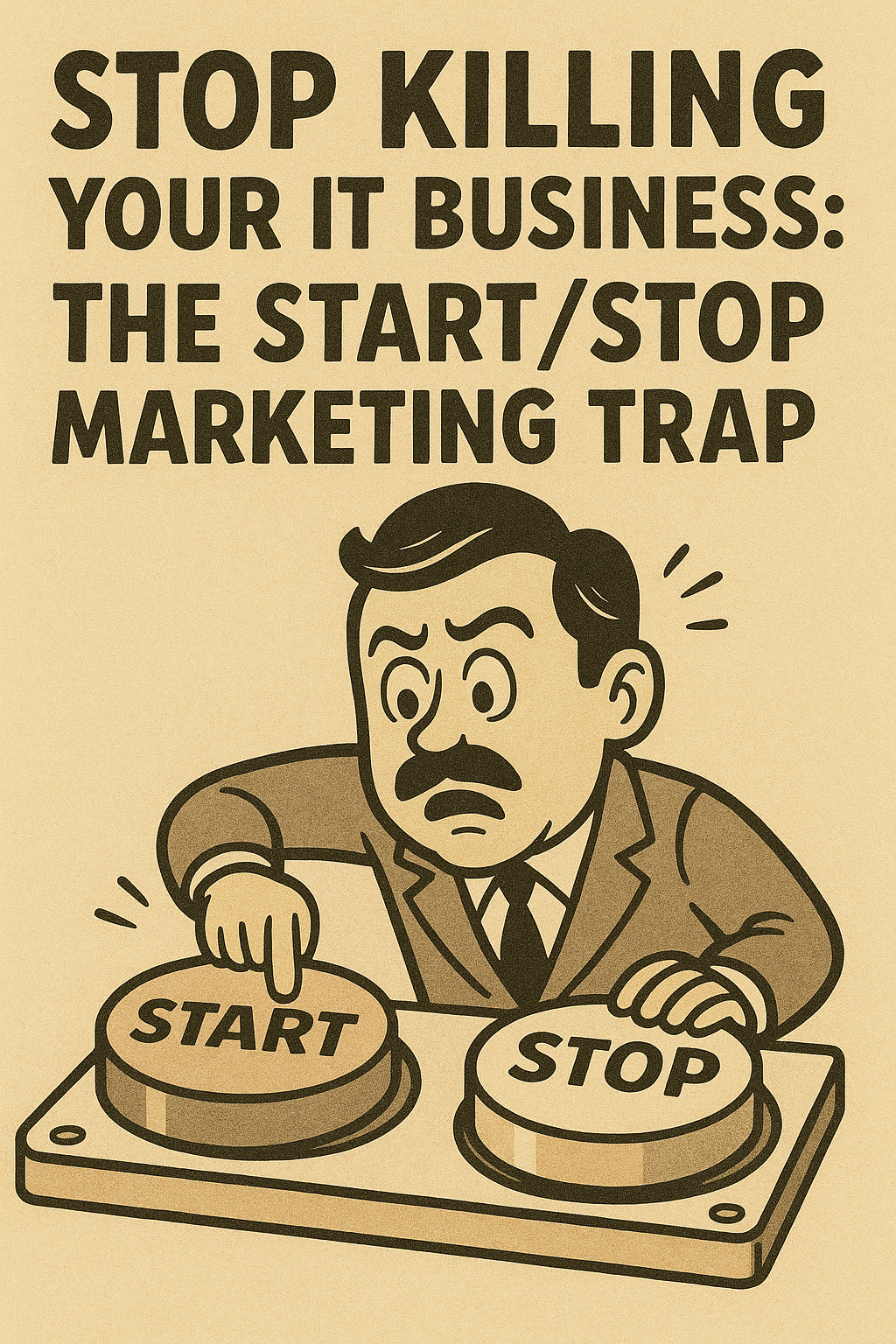
Start/Stop is killing your IT marketing

Stop Killing Your IT Business: The Start/Stop Marketing Trap

Introduction

Start/stop marketing is slowly killing your IT business. You know the pattern: launch a marketing campaign with enthusiasm, run it for 3-5 weeks, see minimal results, then abandon it completely. Sound familiar?

Here’s the brutal truth most IT service providers refuse to accept: marketing takes 4-6 months to start working. Yet most IT owners quit after just a few weeks, expecting instant results in a world that doesn’t work that way.

This destructive cycle is what I call the “start/stop marketing trap” the #1 killer of IT service providers. Every time you stop and restart, you’re not just wasting money. You’re destroying momentum, confusing prospects, and guaranteeing inconsistent lead flow.

Marketing isn’t an event. It’s infrastructure.

Just like you wouldn’t turn off your backup systems or network monitoring tools, you can’t treat marketing like an emergency response that only kicks in when revenue drops. Successful IT providers understand this fundamental truth: marketing requires sustained effort measured in months, not weeks.

The solution? A 90-day consistent marketing plan that builds momentum systematically. Execute the plan. Measure results. Turn those 90 days into forever.

Where do you start? LinkedIn. It’s the second place your prospects look after Google, and it’s the quickest win that creates immediate momentum for everything that follows.

However, be cautious of potential MSP marketing failures during this process, such as misusing platforms like BNI or Google Ads without a clear strategy.

To ensure success in your marketing efforts, consider implementing a write-your-own-guarantee strategy that can help build trust with your clients and prospects alike.

For more insights on navigating the complexities of B2B IT growth and overcoming common challenges faced by service providers, check out our latest news section where we regularly publish articles related to B2B IT growth and other relevant topics.

The Start/Stop Marketing Trap: Why It Kills IT Service Providers

The Cycle of Inconsistent Marketing

Picture this scenario: An IT service provider launches a LinkedIn campaign with enthusiasm, posts daily for three weeks, sends connection requests, and creates content. Week four arrives with no immediate results. Frustration sets in. By week five, the campaign dies a quiet death, abandoned like yesterday’s mechanical hard drives.

This pattern of inconsistent marketing destroys more IT businesses than any competitor ever could. The harsh reality? Marketing operates on a 4-6 month timeline before meaningful results emerge. Your prospects need multiple touchpoints across several months to move from awareness to trust to purchase decisions.

The Cost of Stopping

When you quit after 3-5 weeks, you’re stopping precisely when the foundation starts forming. Each restart means rebuilding from zero, burning cash and time while competitors who maintain consistency capture the leads you could have secured.

Marketing momentum works like compound interest, early efforts seem insignificant, but sustained activity creates exponential returns. Stop/start cycles break this momentum, forcing you back to square one repeatedly.

The Hidden Costs

The cost extends beyond wasted resources:

  • Prospects forget you exist during inactive periods
  • Search algorithms penalize inconsistent content creators
  • Referral partners lose confidence in unreliable marketing presence
  • Lead generation failure becomes a self-fulfilling prophecy

The Importance of Consistency

Your IT infrastructure runs 24/7 because downtime kills productivity. Your marketing deserves the same reliability commitment.

In these challenging times, it’s crucial for IT service providers to diversify their lead sources and avoid the referral crisis. Leveraging a Managed Prospecting System, can provide highly qualified lead generation and sales opportunities tailored for B2B technology companies. This system not only helps in maintaining consistent marketing efforts but also ensures that your business remains visible and relevant in the competitive landscape.

Marketing as Infrastructure: Changing Your Mindset

Your data backup runs every night without fail. Your network monitoring alerts you the moment something goes wrong. Your security patches deploy on schedule. These systems operate continuously because you understand the catastrophic cost of failure.

Marketing infrastructure deserves the same treatment.

Most IT service providers treat marketing like a fire drill, scrambling for clients only when revenue drops. This reactive approach creates the feast or famine cycle that keeps you perpetually stressed about your pipeline.

Successful IT providers think differently. They recognize that IT lead generation isn’t an emergency response, it’s a staple of your business. Just like you have systems for backing up data and monitoring networks, you need systems for generating leads and nurturing prospects.

Consider the parallels:

  • Backup systems run continuously to prevent data loss
  • Network monitoring operates 24/7 to catch issues before they become disasters
  • Security protocols maintain constant vigilance against threats
  • Marketing infrastructure should operate consistently, not sporadically

When you shift from treating marketing as an emergency fix to viewing it as essential infrastructure, something powerful happens. Your lead flow becomes predictable. Your sales conversations increase in quality because prospects encounter your expertise repeatedly. Your business develops the kind of sustainable growth that doesn’t depend on panic driven campaigns.

The consistent execution of marketing activities builds compound momentum that emergency efforts simply cannot match.

For instance, implementing a managed prospecting system can create and implement high converting LinkedIn and Email Lead Generation campaigns targeting new business leads and appointments ideal for you. It’s also crucial to understand that cold prospecting may not be yielding the desired results, but this can be fixed by adding warmth to your approach, as suggested in this guide.

Furthermore, leveraging effective Salesforce lead generation strategies can significantly enhance your business growth. And if you’re looking for specific advice on generating leads on LinkedIn, these 10 essential tips could prove invaluable. Lastly, understanding your ideal client avatar can greatly improve your lead generation efforts.

The 90-Day Marketing Plan: Your Roadmap to Consistency

Start/stop marketing is slowly killing your IT business. Most IT owners quit marketing after 3-5 weeks when it takes 4-6 months for marketing to mature. The solution? A structured 90-day plan that transforms sporadic efforts into a reliable lead generation system.

This isn’t about perfection. It’s about building the habit of consistent marketing execution. You optimize LinkedIn this week, leveraging a LinkedIn B2B lead generation service next week to create a content calendar, then start outreach in week three, measure and adjust in week four, and by day 90, you have a system that works.

Week 1: LinkedIn Optimization The Quick Win

LinkedIn deserves your immediate attention because it’s the second place prospects look after Google when researching IT providers. While your competitors fumble with generic profiles, you’ll create a magnet for ideal clients.

Your LinkedIn Profile Transformation Checklist:

1. Banner Optimization: Ditch the generic tech background with servers and cables. Create banner text with a clear value proposition for your ideal client. Instead of “IT Solutions,” try “We eliminate IT headaches for growing law firms.”

2. Outcome Focused Headline: Stop saying “IT Support” or worse “Managed Services.” Say what outcome you deliver: “I help law firms eliminate IT downtime and data breaches” or “I secure medical practices against cyber threats while ensuring HIPAA compliance.”

3. Conversational About Section: This isn’t your resume. Write it like you’re talking to a stressed business owner at 2 AM when their server crashed. Address their pain points directly: “Your IT shouldn’t keep you awake at night worrying about data breaches or system failures.”

4. Keyword Aligned Job Position: Make your current position match your headline and include keywords your prospects actually search for. “Chief Technology Officer” means nothing to a panicked business owner. “IT Security Specialist for Healthcare Practices” speaks their language.

5. Client Focused Skills Section: Remove “Microsoft Office,” “Leadership,” or “Team Building.” Add specific solutions your ideal clients desperately need:

  • AI Implementation
  • HIPAA Compliance
  • Ransomware Protection
  • Cloud Migration
  • Disaster Recovery Planning

Professional Profile Picture: If your profile picture is from your cousin’s wedding in 2019, fix that first. Prospects want to see a professional, not a wedding guest. Take a quality headshot that conveys competence and approachability, your smart phone camera with a solid background and good lighting will work.

This LinkedIn optimization creates immediate momentum. Prospects researching IT providers will find a professional who understands their specific challenges, not another generic “computer guy.” With the right strategies in place, such as utilizing a Managed Prospecting System for effective lead generation through platforms like LinkedIn and email, you can significantly improve your chances of success in this competitive industry.

Week 2: Creating a Content Calendar to Build Momentum

Your optimized LinkedIn profile sits there like a beautiful storefront with no customers walking by. Start Stop Marketing Is slowly killing your IT Business because most IT owners create content sporadically, posting when they remember or when panic sets in about lead flow.

A content calendar transforms random posting into a structured marketing machine that feeds your lead generation system consistently. Planning content prevents the feast or famine cycle that destroys momentum in your 90-day plan.

Essential Content Types for IT Service Providers:

  • Case Studies – “How we saved XYZ Law Firm $50,000 after their ransomware attack”
  • Cybersecurity Tips – Weekly security alerts and prevention strategies
  • Client Success Stories – Before/after scenarios showing tangible business outcomes
  • Industry Insights – Commentary on new threats, compliance changes, or technology trends
  • Problem/Solution Posts – Address common pain points your prospects face daily

Schedule posts for maximum visibility during business hours when decision makers scroll LinkedIn. Tuesday through Thursday, 8 AM to 11 AM typically generates highest engagement for B2B content.

Your content calendar becomes the backbone of consistent audience engagement. Each post not only builds authority and demonstrates expertise but also keeps your name visible to prospects researching IT solutions.

Content consistency separates thriving IT businesses from those trapped in the start stop cycle. Your prospects need to see you as the reliable expert who shows up consistently, not the vendor who disappears for months between desperate sales pushes. By leveraging a well structured content calendar, you can build market authority that sets you apart from competitors and attracts more leads.

Week 3: Starting Outreach Connecting With Prospects

Your optimized LinkedIn profile and content calendar have built the foundation. Week three transforms that foundation into active lead generation through strategic outreach. This is where your 90-day plan shifts from preparation to direct prospect engagement.

Personalized LinkedIn Messages That Work

Skip the generic “I’d love to connect” requests. Successful IT outreach requires research and relevance. Reference a specific post they shared, mention a mutual connection, or acknowledge a recent company milestone. Your message should sound like you actually visited their profile, not like you’re using a template.

Structure your initial message around their business challenges:

  • “I noticed your recent post about cybersecurity concerns…”
  • “Saw your company just expanded to a second location…”
  • “Your LinkedIn activity suggests you’re dealing with compliance requirements…”

Email Campaigns That Complement Your LinkedIn Efforts

LinkedIn connections open doors, but email campaigns maintain momentum. Your structured marketing approach requires both channels working together. When someone accepts your LinkedIn connection, follow up with a valuable email within 48 hours.

Send industry specific insights, not sales pitches. Share a relevant case study about how you helped a similar business solve their exact problem. Attach a one page guide addressing their specific pain points.

Focus on Problems, Not Products

Your outreach succeeds when you position yourself as the solution to their sleepless nights, not as another vendor selling services. Address the real issues keeping business owners awake: data breaches, system downtime, compliance failures, or productivity losses.

This consistent outreach approach prevents the Start Stop Marketing trap that kills most IT businesses. Week three establishes the rhythm that carries your lead generation system through month two and beyond.

Week 4: Measuring Results and Adjusting Strategies

Your 90-day plan reaches its first critical checkpoint. The difference between IT service providers who succeed and those trapped in start/stop marketing cycles lies in what happens next: measurement and refinement.

Track these essential metrics weekly:

  • LinkedIn profile views – Should increase 25-40% from baseline
  • Connection requests accepted – Aim for 40%+ acceptance rate
  • Message response rates – Target 15-20% for personalized outreach
  • Content engagement – Comments and shares indicate message resonance
  • Qualified conversations – Prospects discussing actual pain points

Most IT owners quit marketing after 3-5 weeks when it takes 4-6 months for marketing to start working. Week 4 separates the committed from the quitters.

Create a simple tracking spreadsheet. Record weekly numbers every Friday. No fancy dashboards needed, just consistent data collection that reveals patterns.

Monthly review sessions prevent drift.

Schedule 90 minutes at month’s end to analyze what’s working. Did your “HIPAA Compliance for Medical Practices” messaging generate more responses than generic IT support language? Double down on what resonates.

Your structured marketing approach demands course corrections based on real data, not assumptions. If connection acceptance rates drop below 40%, revisit your outreach messaging. Low content engagement signals the need for more client-focused topics.

This measurement discipline transforms your lead generation system from guesswork into predictable revenue infrastructure. Week 4 builds the analytical foundation that sustains your marketing beyond the initial 90 days.

Building Long Term Marketing Systems Beyond Day 90

Your 90-day foundation transforms into scalable marketing processes that generate predictable results month after month. The profile optimization, content calendar, and outreach methods you’ve established become the backbone of sophisticated lead nurturing systems designed for sustainable growth.

Leveraging Automation for Efficiency

Smart IT service providers leverage automation tools to amplify their efforts without sacrificing the personal touch that wins clients. Customer relationship management platforms track prospect interactions, while email sequences deliver valuable content to warm leads over time. LinkedIn automation tools can handle initial connection requests, but your personal responses to interested prospects remain crucial for conversion.

This is where the expertise of Managed Prospecting System, a leader in B2B Technology Marketing & Business Growth, becomes invaluable. They provide insights on how to systematize what works while maintaining authenticity in your communications.

Expanding Your Content Strategy

Your content calendar expands beyond LinkedIn to include:

  • Weekly blog posts addressing common IT pain points
  • Monthly case studies showcasing client transformations
  • Quarterly webinars demonstrating your expertise
  • Automated email sequences nurturing prospects through the buying journey

These systems operate continuously, generating leads while you focus on serving existing clients. The sporadic, reactive marketing approach that once consumed your time evolves into a predictable engine driving consistent business growth.

Creating Reliable Marketing Infrastructure

Your marketing infrastructure now functions like your clients’ critical IT systems, reliable, monitored, and continuously optimized. This shift from ad hoc campaigns to systematic processes creates the foundation for scaling your IT business beyond the limitations of personal networking and referrals alone.

One effective strategy for achieving this is by optimizing your outsourced lead generation process. Here are 10 steps that can help streamline this process.

Furthermore, incorporating EEAT principles into your SEO strategy can significantly enhance your online visibility and attract more potential clients.

Finally, mastering the art of conducting successful discovery calls is crucial in converting leads into clients.

Overcoming Common Objections and Pitfalls in Marketing Consistency

“I’ve been posting on LinkedIn for three weeks and got zero leads.”

This statement reveals the core problem plaguing IT service providers. Impatience in marketing drives more business failures than any technical incompetence ever could. Most IT owners quit marketing after 3-5 weeks when it takes 4-6 months for marketing to start working.

The math is brutal but simple: Start Stop Marketing Is slowly killing your IT Business.

The Excuse Factory

IT providers excel at creating sophisticated backup systems but crumble when building marketing consistency. Here are the common excuses IT providers make:

  • “I don’t have time for social media” – Yet they spend hours troubleshooting the same recurring client issues
  • “Marketing feels too salesy” – While charging $150/hour for services that could be automated
  • “I tried LinkedIn and it didn’t work” – After posting twice in two months

The Mindset Shift That Changes Everything

Consider this: You wouldn’t shut down your monitoring system because it didn’t prevent every issue in the first month. You understand monitoring provides cumulative value over time.

Marketing operates identically.

Case in point: One MSP owner I worked with posted consistently on LinkedIn for 90 days without a single inbound lead. Week 12, a law firm partner who had been silently following his content for months reached out. The resulting contract? $8,400 monthly recurring revenue.

The content didn’t “fail” for 11 weeks. It was building trust while the prospect evaluated options.

Practical Persistence Strategies

Track leading indicators, not just results:

  1. Profile views increasing week over week
  2. Connection acceptance rates improving
  3. Content engagement growing gradually

Set micro-goals:

  1. Week 1: Optimize profile completely
  2. Week 2: Publish three valuable posts
  3. Week 3: Send 10 personalized connection requests

These small wins compound into significant momentum, preventing the destructive start-stop cycle that kills IT businesses.

For further insights into overcoming these challenges and achieving marketing success, consider tuning into the Prophets of IT Podcast. This podcast features interviews with successful business owners and executives who share valuable tidbits on what has made them successful in the IT sector.

Bonus Tips for Maximizing Your LinkedIn Impact Today

Your professional branding on LinkedIn can make or break your first impression with potential clients. While many IT service providers focus on technical certifications and service offerings, they often overlook the fundamental elements that establish instant credibility.

The profile picture importance cannot be overstated. That casual photo from your nephew’s wedding or the blurry selfie from your last vacation sends the wrong message to business owners seeking reliable IT partners. Decision-makers want to work with professionals who understand the gravity of protecting their digital assets.

Here are immediate fixes that transform your LinkedIn presence:

  • Invest in a professional headshot – Clean background, business attire, direct eye contact with the camera
  • Optimize your banner image – Include your company logo and a clear value proposition like “Protecting Small Businesses from Cyber Threats”
  • Craft a compelling headline – Replace generic titles with outcome-focused statements: “IT Director → Helping Law Firms Achieve 99.9% Uptime”
  • Update your contact information – Make it effortless for prospects to reach you with multiple contact methods

These changes take less than an hour to implement but create lasting impact. When a stressed business owner discovers your profile through search or referral, they form an opinion within seconds. Your professional appearance signals competence, reliability, and attention to detail – qualities every business owner desperately needs in their IT partner.

Want me to personally review your LinkedIn profile and give you specific fixes?

Book a 15-minute LinkedIn Profile Pit Stop (on me): https://calendly.com/890/pitstop

I’ll examine your “tires, gas, and wedge” (Headline, About section & Skills) and provide the exact changes to make.

No pitch. Just quick fixes you can implement immediately.

Most IT service providers will read this article and do nothing.

Are you most IT service providers?

FAQs (Frequently Asked Questions)

What is the Start/Stop Marketing Trap and how does it harm IT service providers?

The Start/Stop Marketing Trap refers to the cycle of inconsistent marketing efforts where IT service providers launch campaigns but quit after 3-5 weeks. This inconsistency kills momentum, wastes resources, and causes prospects to forget about your services, ultimately harming your IT business growth.

Why is consistency crucial in marketing for IT businesses?

Consistency in marketing is vital because it builds trust, maintains brand visibility, and nurtures relationships with prospects. Just like your IT infrastructure runs 24/7 to prevent downtime, your marketing needs to be continuous to avoid losing potential clients and wasting previous efforts.

How can IT service providers create a reliable marketing infrastructure?

IT service providers can create reliable marketing infrastructure by treating marketing like their IT systems, running consistently without fail. This includes leveraging automation tools, expanding content strategies beyond LinkedIn, tracking key metrics regularly, and maintaining a structured 90-day marketing plan that evolves into scalable processes.

What are the key steps in the 90-Day Marketing Plan for IT service providers?

The 90-Day Marketing Plan involves four main steps: Week 1 – LinkedIn Profile Optimization; Week 2 – Creating a Content Calendar with essential content types like case studies; Week 3 – Starting personalized outreach through LinkedIn messages and email campaigns focusing on client problems; Week 4 – Measuring results by tracking metrics such as profile views and adjusting strategies accordingly.

How should IT service providers approach outreach to prospects effectively?

Effective outreach involves personalized LinkedIn messages that avoid generic requests, complemented by targeted email campaigns. The focus should be on addressing the prospect’s problems rather than just promoting products, positioning yourself as a solution provider who understands their unique challenges.

What mindset shift can help IT businesses overcome common objections to consistent marketing?

The critical mindset shift is treating marketing as essential infrastructure just like backup or monitoring systems, that must run continuously. Instead of expecting immediate results or quitting early, IT businesses should practice practical persistence by tracking leading indicators such as profile views and engagement to build long-term success.


 

Retro style cartoon of an MSP owner launching a rocket labeled “Marketing Campaign” in September, symbolizing data driven IT marketing success.

Why September is Your IT Marketing Campaign Launch Window: The Data Driven Case for MSP Success

Last Updated: September 2025 | Reading Time: 13 minutes

By Jim Punzenberger, Founder of ManagedProspectingSystem.com

Introduction: The Summer Marketing Death Valley

Fellow MSP owners, the data is overwhelming: if you’re launching IT marketing campaigns during summer or waiting until “after the holidays,” you’re hemorrhaging potential clients and missing the most profitable timing window of the year.

After analyzing industry research from leading firms like CompTIA, Belkins, Workday, and performance data from millions of B2B interactions, the statistics reveal one undeniable truth: September launches position your campaigns to hit peak effectiveness exactly when SMB budgets are fresh and decision makers are most receptive.

Here’s the statistical proof that will revolutionize your IT marketing timing strategy.

The Summer Response Rate Disaster: Hard Numbers

Let’s start with the brutal reality of summer IT marketing performance. The data doesn’t lie about what you’re facing during July-August:

Business Activity Disruption Statistics:

  • 95% of businesses report prospect holidays affect their business activity (Sagefrog Marketing Research)
  • Nearly 50% say staff breaks actively disrupt workflows and delay technology projects (Intelemark B2B Research)
  • 75% of B2B organizations experience sales drops of 20% or more during summer months (Business 2 Community Analysis)
  • 20% of companies see sales declines exceeding 40% in July-August peak vacation periods

Email and LinkedIn Performance Collapse:

Translation for systems minded MSPs: Your marketing infrastructure is consuming resources while your target market’s network is essentially offline. You’re burning budget with dramatically reduced system efficiency.

September: The Network Recovery Statistics

Now here’s where September becomes mathematically superior. Think of it as when your target market’s decision making network comes back online after extended downtime:

Post Summer Recovery Metrics:

Critical Back to Work Psychology Impact:

Key insight: This isn’t gradual improvement, it’s like switching on a high performance server after summer downtime. Your marketing campaigns suddenly have 45% more processing power to work with.

The Q1 Budget Cycle: Your Mathematical Target Window

Here’s where most MSPs calculate their timing completely wrong. They assume Q4 is about immediate deal closure. The statistics reveal a different optimization strategy:

SMB Budget Allocation Patterns:

Campaign Maturation Mathematical Formula:

  • Marketing campaigns require 4-6 months to reach peak effectiveness (industry standard benchmark)
  • January email open rates hit 38% (year’s highest) (Belkins Annual Email Performance)
  • Q1 budget preparation begins 3-6 months prior (July-September for January fiscal years)

The Mathematical Proof: September Launch + 4-6 Month Maturation = January-March Peak Performance exactly when:

  • Fresh $10,000-$249,000 annual IT budgets activate (CompTIA SMB Spending Analysis)
  • Technology project approval rates peak
  • Decision maker availability maximizes

Competitive Advantage: The September Numbers Game

Perhaps the most compelling statistical argument for September IT marketing launches lies in competitive positioning data:

Marketing Competition Intensity Analysis:

  • 73% of B2B marketers delay campaigns until October or later (Marketing Week B2B Effectiveness)
  • September advertising costs run 23% below Q4 levels due to reduced demand (Sagefrog Seasonal Marketing)
  • 41% fewer active marketing campaigns in September vs. November creating reduced inbox competition

Statistical Advantage Calculation: September launch provides:

  • 4-6 weeks of reduced competition before Q4 marketing intensity
  • Premium engagement rates at off peak advertising costs
  • Significantly less noise in prospect inboxes during campaign initiation

IT Marketing Response Rate Recovery: The Statistical Progression

Want hard numbers on performance improvement? Here’s the month by month progression when you launch in September instead of continuing failed summer campaigns:

Email Response Rates by Month (Belkins 11M Email Analysis):

  • July: 4.2%
  • August: 3.8%
  • September: 7.2% (89% improvement over summer baseline)
  • October: 6.8%
  • November: 6.4%
  • January: 8.1% (year’s peak performance)

LinkedIn Connection Acceptance Rates:

  • Summer average: 12%
  • September: 18% (50% improvement)
  • Q1 average: 21% (75% improvement over summer)

Wednesday Peak Performance (Belkins Day of Week Analysis):

  • Wednesday shows highest reply rates at 7.2% and 37% open rates
  • Tuesday-Thursday represent optimal engagement days for IT services outreach
  • Monday response rates 23% lower due to weekly planning activities

The statistical reality: September launches deliver 89% higher email response rates and 75% better LinkedIn acceptance rates compared to summer baseline, with continued improvement through Q1 target window.

SMB Technology Budget Timing: The Financial Optimization Data

Here’s the financial research that makes September launches mathematically superior for IT marketing:

SMB IT Spending Statistical Profile (CompTIA Technology Buying Trends):

  • Average IT spending: 4-6% of total company revenue
  • Small business IT budget average: 6.9% of revenue
  • Medium business IT budget average: 4.1% of revenue
  • Annual spending range: $10,000-$249,000 per SMB
  • 64% of SMBs consider technology primary factor in business objectives

Budget Cycle Timing Statistics:

  • Budget preparation timeline: 3-6 months before fiscal year end
  • Emergency IT spending: 30% of budget (peaks during summer equipment failures)
  • Planned IT spending: 70% of budget (aligns with annual budget cycles beginning Q1)
  • 37% of 25+ employee SMBs are centralizing IT purchasing decisions, increasing MSP opportunities

Translation: Your September launched campaign hits peak maturation exactly when 70% of IT budgets (planned spending portion) becomes available for new MSP relationships and technology initiatives.

Channel Specific IT Marketing Timing Optimization

LinkedIn Outreach Peak Performance Windows (LinkedIn B2B Marketing Research):

  • Tuesday-Thursday, 10-11 AM: Peak IT decision maker activity
  • September-November: 45% higher engagement than summer baseline
  • December shows 18% engagement increase (contrary to holiday assumptions)

Email Campaign Statistical Optimization (Belkins Email Timing Study):

  • Wednesday 8 AM: Highest response rates (7.2%)
  • Early morning sends (5-8 AM): 25% higher reply rates
  • Tech executive preference: 8-9 AM send times for maximum visibility

Content Marketing Performance Windows:

  • Tuesday-Thursday 10 AM-2 PM: Optimal B2B content engagement
  • September launch: Reduced content competition, higher organic reach
  • Consistency over volume: 1-2 monthly blog posts outperform sporadic high volume approaches

System Optimization: The September Launch Configuration

Based on comprehensive statistical analysis, here’s the optimal IT marketing campaign configuration:

Phase 1 – September Launch Window (September 1-15):

  • Capture 45% post summer engagement recovery
  • Begin 4-6 month campaign maturation cycle
  • Benefit from 41% reduced marketing competition
  • Implement 3-pillar MPS approach for maximum effectiveness

Phase 2 – Q4 Pipeline Building (October-December):

  • Campaign building during budget finalization season
  • November shows 11-24% above average tech services revenue (FastSpring Software Analysis)
  • December maintains 18% higher LinkedIn engagement than expected

Phase 3 – Q1 Peak Performance (January-March):

  • Campaign maturation aligns with fresh budget availability
  • 38% email open rates (year’s highest performance)
  • 67% increase in new IT project starts
  • Maximum ROI on September campaign investments

Statistical Expected Outcomes: The Performance Forecast

Organizations implementing September IT marketing launches can expect:

Immediate Performance Gains:

  • 89% higher response rates vs. summer campaign continuation
  • 45-52% engagement improvement over seasonal baseline
  • 23% cost savings compared to Q4 launch timing

Q1 Peak Performance Metrics:

  • Campaign maturation coincides with fresh budget availability
  • Maximum decision maker accessibility and purchasing authority
  • Compound effect of 6 months of relationship building during budget preparation

Annual Revenue Impact (MPS Client Results):

  • Mature campaigns average 1-3 qualified leads weekly
  • Revenue increases up to $2M for committed implementations
  • System reaches full effectiveness months 4-6 post launch

People Also Ask: Common IT Marketing Timing Questions

Q: Why is September better than October for IT marketing campaigns? A: Statistical analysis shows September provides 4-6 weeks of reduced competition (73% of marketers wait until October), 23% lower advertising costs, and optimal timing for Q1 campaign maturation when fresh budgets activate.

Q: What’s the best day and time to send IT marketing emails? A: Belkins’ analysis of 11 million emails shows Wednesday at 8 AM delivers 7.2% response rates and 37% open rates, with Tuesday-Thursday being optimal days for B2B IT outreach.

Q: How long does it take for IT marketing campaigns to mature? A: Industry data consistently shows 4-6 months for peak campaign effectiveness, making September launches ideal for Q1 budget season when SMBs allocate 70% of planned IT spending.

Q: Should MSPs avoid marketing during holidays? A: Research shows December LinkedIn B2B engagement actually increases 18% over expectations, while January delivers year’s highest email open rates (38%), making consistent year round marketing optimal.

Take Action: Your Authority Building Opportunity

The statistics are overwhelming: September launches create the perfect convergence of reduced competition, recovering engagement rates, and campaign maturation timing that peaks exactly when SMB budgets are fresh and IT decision making capacity maximizes.

Don’t wait until “after the holidays” – that means missing the 4-6 month maturation window and launching when competition is 41% higher and costs are 23% more expensive.

The data proves September timing isn’t just better it’s mathematically superior.

Ready to implement a data driven September launch strategy? Our 3-pillar system combining content, LinkedIn, and email has helped MSPs generate over $2M in additional revenue through proven timing optimization.


🧀 Ready to Stop Being the Best Kept Secret in Your Market?

Book your 22 Minute MSP Authority Assessment and discover:

✅ Current Positioning Review – Where you stand today and why prospects aren’t finding you
✅ Custom 90-Day Authority Roadmap – Step by step plan to become the IT expert everyone calls first
✅ LinkedIn Profile Audit – Quick fixes that transform your profile into a lead magnet
✅ Content Strategy Starter – Your first authority piece mapped out and ready to publish
✅ Immediate Action Steps – 3 things you can implement this week to start building market authority

Investment: $0. No sales pitch, just actionable advice from someone who’s built and sold an MSP.

Perfect for MSP owners who: Are tired of competing on price, want predictable lead generation, and are ready to become the go to IT authority in their market.

Schedule Your Authority Assessment Now →


About the Author: Jim Punzenberger is a former MSP owner with 20+ years of IT industry experience. After building and selling his own IT company, he’s helped hundreds of MSPs generate over $2M in new revenue through proven authority building strategies. Host of the Prophets of IT Podcast and creator of the Managed Prospecting System.

Related Resources:

1950s cartoon style illustration of a frustrated MSP owner at a desk with empty pockets, while a slick marketing agency figure dreams of money, symbolizing wasted spending on marketing agencies.

The Honest MSP Owner’s Guide to Why Marketing Agencies Keep Taking Your Money and Delivering Nothing

Last Updated: September 2025 | Reading Time: 12 minutes

If you’re an MSP owner in the United States or Canada reading this, chances are you’ve already wasted $15,000-$50,000 or more on a marketing agency that promised “qualified leads” and delivered tire-kickers who ghosted you after seeing your pricing.

According to GTIA’s 2024 State of the Channel Report, 68% of MSPs report being “somewhat” or “very dissatisfied” with their marketing results. Yet the managed services market continues to grow, with Grand View Research projecting 13.6% CAGR through 2030.

The disconnect? Most marketing agencies don’t understand the MSP business model, your sales process, or what actually converts managed services prospects.

Why Generic Marketing Agencies Fail MSPs

They Get Paid With No Accountability

Here’s the harsh reality: Most marketing agencies operate on retainer models with zero accountability for actual business results. According to HubSpot’s State of Marketing Report, only 34% of agencies tie their compensation directly to client results.

What This Looks Like for MSP Owners:

  • Monthly retainer comes out automatically whether leads close or not
  • “We delivered the impressions/clicks/calls you paid for” (but nothing closed)
  • When results disappoint, they blame YOUR sales process, YOUR pricing, YOUR follow-up
  • You’re locked into 6-12 month contracts while they collect guaranteed payments

They Don’t Understand MSP Business Models

The fundamental problem? Generic marketing agencies think “MSP” means “computer repair shop.” They don’t grasp the difference between:

  • Break-fix vs. managed services revenue models
  • Monthly recurring revenue vs. project-based billing
  • Strategic IT partnership vs. technical support calls
  • Proactive monitoring vs. reactive problem-solving

This ignorance leads to campaigns that attract the wrong prospects entirely.

They Use One Size Fits All Approaches

Most agencies apply the same “IT services” template whether you’re targeting:

  • 15-employee law firms in Toronto
  • 75-person manufacturing companies in Dallas
  • Healthcare practices in Phoenix
  • Financial services firms in Vancouver

The result? Generic messaging that sounds like every other MSP in your market.

The Real Problems MSP Owners Face With Marketing Agencies

Problem #1: Wrong Appointments With Wrong People

The Promise: “We’ll book qualified appointments with decision-makers”

The Reality:

  • Meetings with office managers who “handle the computers”
  • 30 minutes in: “My boss makes IT decisions. He’s not here today…”
  • Decision-makers who never heard of the meeting and aren’t interested

Geographic Insight: This problem is especially acute in smaller markets across the Midwest and Southeast, where business hierarchies are less defined and “IT person” could mean anyone from the CEO’s nephew to the part-time bookkeeper.

Problem #2: Appointments With Wrong Company Sizes

The Promise: “Leads that match your ideal client profile”

The Reality:

  • “We have 50 employees!” (Actually: 3 employees, 1 broken laptop)
  • “We need enterprise support!” (Budget: $200/month total)
  • Your minimum monthly commitment exceeds their entire annual IT budget

According to ConnectWise’s 2024 MSP Trends Report, the sweet spot for most profitable MSP engagements is 25-150 employees, yet many agencies consistently book meetings with 3-10 person businesses that can’t afford managed services.

Problem #3: Appointments That Don’t Show Up

The Statistics: According to Salesforce Research, cold generated appointments have no-show rates of 45-65%, compared to 8-18% for warm, inbound generated appointments.

Why This Happens:

  • Prospects agreed to meetings under pressure
  • No real buying intent or timeline
  • Never confirmed genuine interest in managed services
  • Booking process didn’t qualify actual need

Problem #4: Geographic Mismatches

Common Scenario: Your MSP serves businesses within 50 miles of Chicago, but the agency books meetings with companies in Milwaukee (90+ miles away) because “they’re both in the Midwest.”

The Impact: You waste time on prospects you can’t realistically serve, while missing opportunities in your actual service area.

What Separates MSP Marketing From Generic IT Marketing

Understanding the MSP Sales Cycle

Unlike selling software or consulting services, MSP sales cycles typically span 6-18 months. According to Gartner’s B2B Buying Journey Report, 77% of B2B technology buyers evaluate 3-5 providers before making final decisions.

Quick conversion tactics actually repel MSP prospects:

  • Trust building content is essential for long sales cycles
  • Multiple touchpoints across 12 plus months are required
  • Technical credibility must be established before price discussions

MSP Prospect Psychology

Fear Based Decision Making: MSP prospects aren’t buying features, they’re buying peace of mind. Datto’s Global State of the MSP Report 2024 shows that 84% of businesses cite “fear of downtime” as their primary concern when evaluating IT providers.

Trust Over Price: Unlike commodity purchases, MSP relationships are built on trust. Prospects will pay 20 to 40% more for providers they trust, according to GTIA’s Channel Partner Research.

Regional Market Differences

United States MSP Markets:

  • Northeast: Higher budgets, longer evaluation periods, compliance-focused
  • Southeast: Relationship driven, referral heavy, value conscious
  • Midwest: Conservative decision-making, proven-solution preference
  • West Coast: Technology-forward, growth-focused, innovation-oriented

Canadian MSP Markets:

  • Ontario: Enterprise-focused, regulation heavy, relationship based
  • Western Provinces: Resource industry driven, seasonal considerations
  • Bilingual Requirements: Quebec market needs French-language capabilities

How Former MSP Owners Approach Marketing Differently

We’ve Been in Your Shoes

As former MSP owners, we’ve experienced the frustration firsthand:

  • Paying $5,000/month for “leads” that never closed
  • Driving 1 hour to meet a “qualified prospect” who needed home WiFi help
  • Delivering sales presentations to office managers with zero authority
  • Watching competitors win deals because our marketing made us sound generic

We Know What Real Qualification Looks Like

Real MSP Prospects:

  • Meet your ideal client avatar (company size, industry, location)
  • Have raised their hand expressing genuine interest
  • Possess budget alignment for managed services ($2,000+ monthly typical)
  • Include actual decision makers in evaluation process
  • Experience specific IT pain points managed services solve

Our Three-Pillar Integration Approach

Unlike agencies that rely on single-channel tactics, our Managed Prospecting System integrates:

Pillar 1: Content Marketing

  • 2,500+ word industry-specific blog articles
  • Page 1 Google rankings in as little as 48 hours
  • Authority building across your target market
  • Inbound lead generation while amplifying outreach

Pillar 2: LinkedIn Lead Generation

  • Targeted campaigns to your prospect avatar
  • Professional profile optimization
  • Network growth with qualified connections
  • No cold calling = no “get off the phone” meetings

Pillar 3: Email Marketing

  • Strategic campaigns leveraging your content authority
  • Prospect nurturing throughout long sales cycles
  • Integration with LinkedIn and content efforts
  • Pre-qualified interest before appointment booking

The No Cold Calling Difference

Traditional Agency Approach: Cold caller: “Hi, do you need IT help?” Prospect: “Sure, I guess” (just to end the call) Result: Fake appointment with someone who was never interested

Our Authority-First Approach:

  • Prospects consume your content while researching solutions
  • They see your expertise across LinkedIn, Google, social media
  • Email nurturing builds trust over weeks/months
  • They raise their hand and WANT to talk to you

According to our internal metrics, this approach generates:

  • 5% appointment no show rates (vs. 40 to 60% industry average)
  • 93% appointment to proposal conversion rates
  • 32% proposal to close ratios
  • Average deal sizes 40% above market rates

The Only Marketing Guarantee That Matters

You Write Your Own Guarantee

We’re confident enough in our results to let YOU set the terms. Here’s how our unique guarantee process works:

  1. During your strategy call, you tell us what reasonable guarantee would make you comfortable moving forward
  2. We give you an immediate YES or NO, no committee meetings, no “let me get back to you”
  3. If reasonable, we put your guarantee in writing as part of our agreement

What Makes Guarantees Reasonable vs. Unreasonable

✅ Reasonable Guarantees:

  • Based on our performance and lead generation capabilities
  • Tied to measurable milestones we directly control
  • Allow reasonable time for system maturity (leads typically start month 2)
  • Account for normal business cycles and market conditions

❌ Unreasonable Guarantees:

  • Guaranteeing your sales team will close every lead we generate
  • Taking 100% liability for revenue outcomes beyond our control
  • Promising results when clients don’t follow up on qualified leads
  • Expecting immediate results (our system needs 60-90 days to mature)

Why Other Agencies Won’t Offer Real Guarantees

Simple: They can’t afford to back up their promises with guarantees because their results are unpredictable.

Our Advantage: Integrated systems with proven metrics allow us to guarantee specific outcomes with confidence.

Geographic Considerations for MSP Marketing

United States Market Insights

High Opportunity MSP Markets:

  • Dallas Fort Worth: 7.6 million population, business friendly, growing tech sector
  • Atlanta: Healthcare and financial services concentration
  • Denver: Mix of enterprise and mid market opportunities
  • Phoenix: Rapid business growth, technology adoption
  • Chicago: Manufacturing and professional services focus

Competitive Considerations:

  • Northeast markets: Saturated but higher value opportunities
  • California: Highest competition but premium pricing acceptance
  • Texas: Business friendly environment, growing demand
  • Florida: Tourism and hospitality focus, seasonal considerations

Canadian Market Opportunities

Primary Markets:

Market Entry Strategies:

  • Compliance expertise (PIPEDA, provincial regulations)
  • Bilingual capabilities for Quebec market
  • Understanding of Canadian business culture and decision-making
  • Currency and cross-border considerations

Finding the Right MSP Marketing Partner: A Checklist

Essential Questions to Ask Potential Marketing Agencies

Experience Questions:

  1. “How many MSPs have you worked with in the past 24 months?”
  2. “What’s the average deal size your MSP clients close from your leads?”
  3. “Can you explain the difference between break-fix and managed services?”
  4. “What’s your average appointment to close conversion rate for MSP clients?”

Accountability Questions:

  1. “What guarantees do you offer for lead quality and quantity?”
  2. “How do you measure success beyond vanity metrics?”
  3. “What happens if leads don’t meet our avatar requirements?”
  4. “Can we speak with 3 current MSP clients about their results?”

Process Questions:

  1. “Walk me through your lead qualification process”
  2. “How do you ensure appointments are with decision makers?”
  3. “What’s your typical MSP client’s cost per qualified lead?”
  4. “How long before we see our first qualified appointments?”

Red Flags to Avoid

🚩 Generic “IT Services” Positioning

  • Uses same templates for MSPs, computer repair, and software companies
  • Can’t articulate your unique value proposition vs. competitors
  • Focuses on features rather than business outcomes

🚩 Unrealistic Timeline Promises

  • “Leads in 30 days guaranteed”
  • “Immediate ROI from day one”
  • “Quick wins” without understanding MSP sales cycles

🚩 Vanity Metric Focus

  • Emphasizes website traffic over qualified leads
  • Celebrates social media followers instead of appointments
  • Reports impressions rather than conversions

🚩 No MSP Specific Experience

  • Can’t provide MSP client references
  • Doesn’t understand recurring revenue models
  • Uses generic technology terminology

MSP Marketing Success: What to Expect

Realistic Timeline for Results

Month 1: Avatar development, prospect research, campaign setup, content creation begins

Month 2: First qualified leads start flowing from integrated campaigns

Months 4-6: System reaches maturity averaging 1-3 qualified appointments weekly

Year 1: Revenue increases up to $2 million for our best clients following our methodology

Beyond Lead Generation: Complete Sales Assets

Multi-Channel Authority Building:

  • Page 1 Google rankings for target keywords
  • LinkedIn network growth and enhanced professional presence
  • Omnipresent content building authority across all platforms
  • Updated prospect database for events and webinars

Long Term Market Positioning:

  • Recognized expertise in your service area
  • Referral network development
  • Competitive differentiation through consistent messaging
  • Brand recognition driving inbound opportunities

Conclusion: Making the Right Choice for Your MSP

The managed services market will continue growing, but so will the competition. According to Channel Futures MSP 501, there are over 45,000 MSPs in North America, with approximately 1,500+ new providers entering the market annually.

The Question: Will you continue working with marketing agencies that treat you like every other “IT company,” or partner with marketers who understand your business because they’ve built and sold MSPs themselves?

The Choice: Keep writing checks hoping this agency will be different, or work with partners confident enough to let you write your own guarantee.

Your Next Steps

This Week:

  1. Audit your current marketing agency’s MSP specific experience
  2. Calculate your actual cost per qualified lead (not just cost per appointment)
  3. Ask your current provider: “What guarantee will you put in writing?”

This Month:

  1. Interview 2-3 MSP-focused marketing providers
  2. Request client references and speak with actual MSP owners
  3. Define what reasonable guarantee would make you comfortable moving forward

Ready for a Different Approach?

Stop hoping marketing will work and start guaranteeing it will.

As former MSP owners turned marketing experts, we understand your skepticism because we’ve been burned too. That’s why we built the marketing system we wished existed when we owned our MSP and why we’re confident enough to let you write your own guarantee.

Schedule your strategy call today and discover:

  • How our 3-pillar system typically generates 1-3 qualified MSP appointments weekly
  • Why our clients average 32% proposal to close ratios vs. 12% industry average
  • What guarantee would make YOU comfortable moving forward
  • Whether our approach is right for your MSP and market

Schedule Your Strategy Call →

Because if we can’t stand behind our work with a written guarantee, why should you trust us with your marketing?


Jim Punzenberger is a former MSP owner and founder of ManagedProspectingSystem.com. He has helped hundreds of MSPs across the United States and Canada transform their marketing approach and accelerate growth through proven, integrated lead generation strategies designed specifically for the managed services industry.


Frequently Asked Questions About MSP Marketing Agencies

Why do MSP marketing agencies fail to deliver results?

Most marketing agencies fail MSPs because they don’t understand the MSP business model, use generic IT services messaging, operate with zero accountability, and can’t qualify real managed services prospects. They treat MSPs like computer repair shops rather than understanding the recurring revenue model and long sales cycles.

What’s the average MSP marketing agency no show rate?

Cold call generated appointments have no show rates of 45 to 65%, compared to 8 to 18% for warm, inbound generated appointments. This is why agencies that rely on cold calling deliver poor appointment quality.

How long is the typical MSP sales cycle?

MSP sales cycles typically span 6 to 18 months. 77% of B2B technology buyers evaluate 3 to 5 providers before making final decisions, which requires different marketing approaches than quick conversion tactics.

What should MSPs look for in a marketing agency?

MSPs should look for agencies with actual MSP experience, proven results with similar businesses, written guarantees with real consequences, understanding of the managed services sales cycle, and ability to qualify prospects properly based on company size, budget, and decision maker status.

How much should MSPs expect to invest in marketing?

Most successful MSPs invest 10 to 15% of gross revenue in marketing activities. For a $1 million MSP, this translates to $100,000 to $150,000 annually. However, the key is accountability and measurable results, not just budget size.

What’s the difference between MSP marketing and generic IT marketing?

MSP marketing focuses on recurring revenue relationships, longer sales cycles, trust building content, and managed services buyers. Generic IT marketing treats all technology services the same, leading to break fix prospects, wrong company sizes, and price focused conversations.

How can MSPs avoid wasting money on bad marketing agencies?

Ask for MSP specific client references, request written guarantees with real consequences, verify their understanding of managed services business models, and ensure they can explain the difference between break fix and managed services prospects.

What results should MSPs expect from good marketing?

Quality MSP marketing should generate 1+ qualified appointments weekly within 4 to 6 months, with appointment to proposal conversion rates of 80% or higher, and proposal to close ratios of 25% or better for properly qualified prospects.

Why don’t most marketing agencies offer guarantees?

Most agencies can’t afford to guarantee results because their approaches are unpredictable and they lack MSP specific experience. Agencies with proven systems and MSP expertise can confidently guarantee specific outcomes.

What makes former MSP owners better at MSP marketing?

Former MSP owners understand the business from the inside, know what actually converts prospects, have experienced the sales process personally, understand client pain points, and can create messaging that resonates with decision makers because they’ve been decision makers themselves.

Conclusion: Making the Right Choice for Your MSP

The managed services market will continue growing, but so will the competition. According to Channel Futures MSP 501, there are over 45,000 MSPs in North America, with approximately 1,500+ new providers entering the market annually.

The Question: Will you continue working with marketing agencies that treat you like every other “IT company,” or partner with marketers who understand your business because they’ve built and sold MSPs themselves?

The Choice: Keep writing checks hoping this agency will be different, or work with partners confident enough to let you write your own guarantee.


Related Resources:

SEO Keywords: MSP marketing agency, managed service provider marketing, IT marketing agency, MSP lead generation, managed services marketing, MSP business development, IT services marketing, MSP sales, managed services lead generation, MSP marketing company

Geographic Targeting: United States MSP marketing, Canadian MSP marketing, Toronto MSP marketing, Dallas MSP marketing, Chicago MSP marketing, Denver MSP marketing, Atlanta MSP marketing, Phoenix MSP marketing, Vancouver MSP marketing, Calgary MSP marketing